Tanium’s $9B Founder Return: Why Orion Hindawi Took Back the CEO Job
$9 billion companies do not swap CEOs for sentiment. Tanium put founder Orion Hindawi back after three years because, with AI, “steady” can be the expensive mistake.
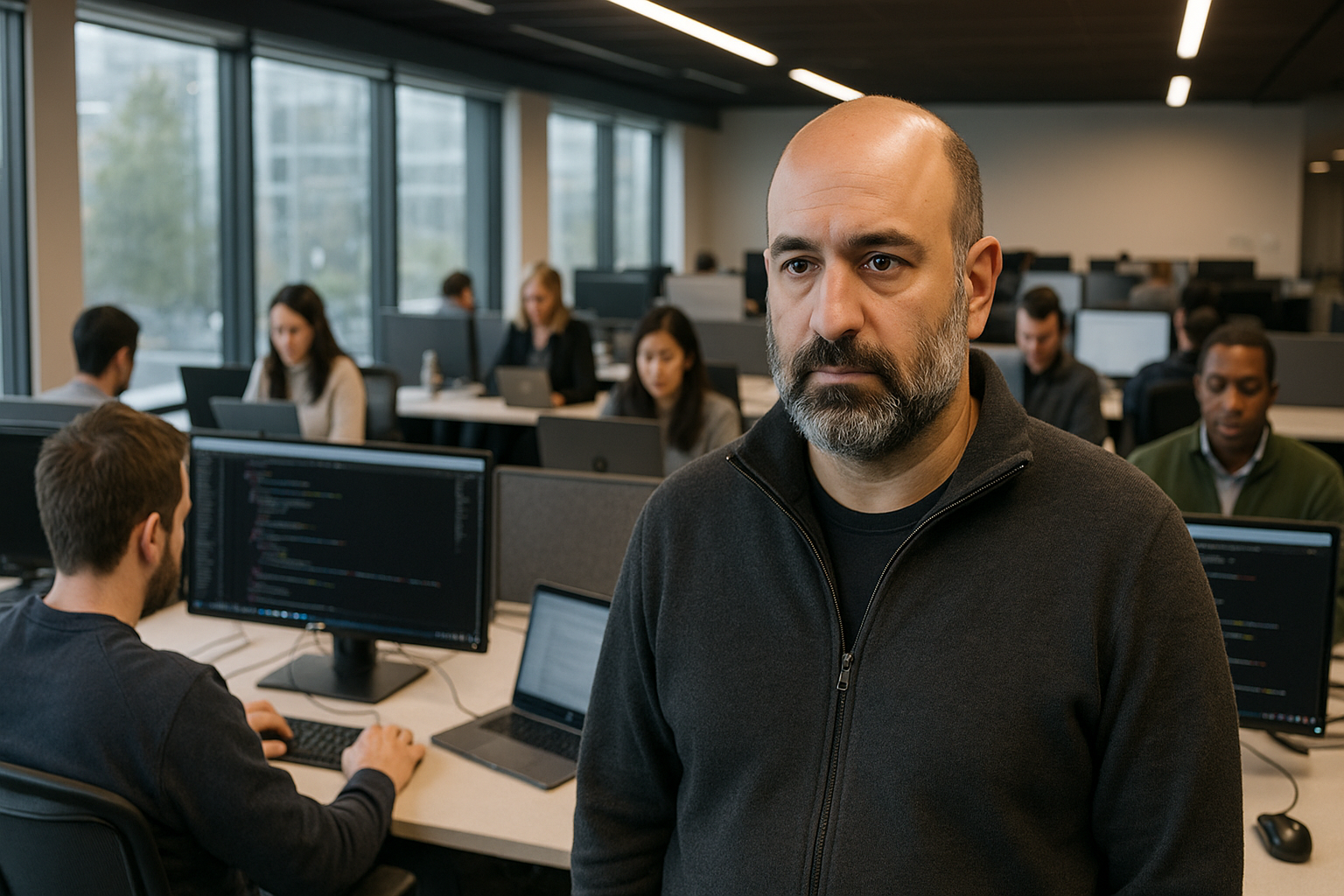
Tanium didn’t bring Orion Hindawi back as CEO because everything was humming along nicely.
At a $9 billion valuation, companies do not replace the CEO, return the founder and change the board chair for sentiment. They do it because the next problem is too consequential to manage with more of the same.
On August 20, Tanium reinstated Hindawi, its co-founder and executive chairman, as chief executive effective immediately. Dan Streetman, who had led the cybersecurity and endpoint-management company for three years, stepped down as CEO and as a board member, though he will remain an adviser during the transition. Orion’s father and co-founder, David Hindawi, returned as board chairman.
That is not a normal succession. It is a founder reclaiming the wheel.
Tanium has put the family back in the driving seat
Tanium is not some tiny startup having a wobble in a WeWork. The company says it has more than $700 million in annual recurring revenue, more than 1,900 employees, 17 offices in 15 countries and a $9 billion valuation. It says its technology manages 36 million endpoints globally and is used by all six branches of the US military, 40% of the Fortune 100, seven of the ten biggest US commercial banks and seven of the ten biggest US retailers.
Those numbers matter because they explain the stakes. When a cybersecurity platform breaks, gets breached or simply falls behind, the consequences are not a few annoyed app users. You are dealing with banks, governments, hospitals and giant companies whose laptops, servers, cloud workloads and employee devices are the front door for criminals.
Hindawi was Tanium’s CEO from 2016 until February 2023, when Streetman took the job and Hindawi became executive chairman. At the time, the split made sense. Streetman came with heavyweight enterprise-software credentials from Allvue Systems, TIBCO, BMC, Salesforce and C3.ai. The mandate was clear enough: make a technically formidable founder-led company more commercially scalable.
By Tanium’s account, Streetman did that. The company says it expanded its go-to-market operation and won strong industry recognition for innovation in its platform during his tenure.
Now the company is changing the recipe again. It wants to deepen its “Autonomous IT” capabilities, expand AI across its portfolio and strengthen customer and partner engagement. That is corporate language, sure, but the evidence is more specific than a generic AI press release: Tanium has named Autonomous IT, AI across the portfolio, and customer and partner engagement as the next priorities.
Underneath that is a dead-simple business decision: the product strategy has become too important to leave at arm’s length from the founder who built the technical architecture.
AI has made the safe CEO choice less safe
Most boards hire an outside operator when they want order. They bring back a founder when they want speed, conviction and a cleaner answer to the question: “What are we actually building?”
The usual management cliché is that founders are brilliant at starting companies but should gracefully step aside once the business gets serious. That is often true. Founders can become bottlenecks. They can confuse intensity with leadership, reject boring but necessary systems, and make every decision feel like a referendum on their identity.
But the opposite error is just as expensive: hiring a polished operator to run a company when the market is being redrawn and the company needs a product-level call every bloody day.
Cybersecurity is one of those markets. AI is making attacks cheaper, faster and more automated. It is also giving security and IT teams new ways to detect, decide and act. That means enterprise customers are not simply buying another dashboard. They are deciding which platforms get permission to see their entire technology estate and take action across it.
That last bit is why Tanium’s AI rationale matters. Tanium says it manages 36 million endpoints globally. When a platform is built to see and act across that kind of estate, AI is not a feature you bolt onto a sales deck. The real questions are what the system can observe, what decisions it can make, what actions it can execute and where a human still has to intervene.
Tanium’s June launch of Tanium Atlas was pitched as an autonomous operating system that combines real-time intelligence, agentic decision-making and execution for IT and security operators. That is the sharper evidence behind the leadership change. Tanium is not merely saying it wants AI somewhere in the business. It has publicly positioned Atlas around real-time intelligence, agentic decision-making and execution.
Whether every bit of that promise lands commercially is beside the point. The category is now being fought over at the level of architecture, trust and product philosophy—not just sales coverage and quarterly pipeline hygiene. Once you claim your system can decide and execute, the quality of product judgement matters more, not less.
That is a founder’s battlefield.
The uncomfortable truth: a founder return is also a board verdict
Let’s not dress this up as a heartwarming reunion. When a board returns the founder to the CEO role after appointing an experienced outside executive, it is making a judgement.
The judgement is not necessarily that Streetman failed. The public announcement credits him with improving operational discipline and scaling go-to-market efforts. But boards do not reshuffle a CEO, executive chairman and board chair because they are bored on a Wednesday.
They do it because the next phase requires a different kind of leadership.
This is the bit many executives hate hearing: being good at the job you were hired to do does not entitle you to run the next chapter. Markets move. A company’s bottleneck moves. The skills that got the business from $100 million to $700 million in recurring revenue may not be the skills that get it from a powerful endpoint-management platform to the operating layer for autonomous enterprise IT.
Streetman’s assignment appears to have been scale. Hindawi’s new assignment is reinvention.
That distinction matters for every founder and every board. Stop treating the CEO job as one job. It is a sequence of jobs. Builder. Seller. Simplifier. Cost cutter. Acquirer. Public-company steward. Turnaround artist. Product visionary. Sometimes one person can do several. Very rarely can one person do all of them at the required level.
The overlooked angle: the Hindawis have removed the excuses
There is another angle here that is more interesting than the standard “founder comes back” headline.
Orion Hindawi is now CEO. David Hindawi is chairman. The people with the deepest historical connection to Tanium’s product, reputation and ownership are once again holding the two most consequential seats in the building.
That can be brilliant. It can also be dangerous.
The upside is speed. Decisions can be made without endless internal theatre. There is likely to be far less ambiguity about product priorities, customer promises and what gets funded. In a market moving this fast, that is a real competitive advantage.
The downside is equally obvious: concentrated founder control can make it harder for senior people to challenge bad assumptions. A founder return only works if it comes with more truth, not more fear. If every executive starts guessing what the founder wants rather than saying what the business needs, you have not built an AI company. You have built a very expensive echo chamber.
The smart test is not whether the founder is charismatic or technically gifted. It is whether the company can now make faster decisions and surface bad news earlier.
For Tanium, there is an even more practical test. Its stated push is towards Autonomous IT, AI across the portfolio and stronger customer and partner engagement. If those priorities produce clearer product decisions and better outcomes for customers, the founder return has done its job. If they produce vague “agentic” messaging and centralised decision-making, it has not.
If Hindawi creates that environment, Tanium may get the best of both worlds: founder urgency built on the commercial machinery Streetman helped strengthen. If he simply recentralises every meaningful call, the business may move fast right up until it drives into a wall.
Why investors should care about a $9B private-company reset
Private-company CEO changes are often treated as internal housekeeping because there is no public share price flashing red on CNBC every minute. That is lazy.
A company carrying a $9 billion valuation and more than $700 million in recurring revenue is not playing with seed-round money. Its customers, employees, lenders and investors all need to know whether the leadership change is a tactical refinement or an admission that the prior structure was too slow for the moment.
The sensible read is neither panic nor applause. It is scrutiny.
Watch the next two or three quarters for practical evidence. Does product velocity improve? Do major customers expand their deployments? Does the company retain senior operators who can challenge the founder? Does the AI strategy turn into customer outcomes rather than fancy conference demos? And, crucially, does Tanium explain its positioning in plain English?
The evidence worth watching is not whether Tanium uses the words “AI” or “agentic” more often. It is whether its claim around real-time intelligence, decision-making and execution translates into safer, clearer and more useful work for IT and security operators.
The companies that win this phase will not be the ones shouting “agentic” the loudest. They will be the ones that can safely automate high-stakes work without turning a customer’s IT estate into a live experiment.
What this means for you
If you run a company, take the emotion out of succession planning. Do not ask, “Who deserves the CEO title?” Ask, “What is the company’s biggest constraint for the next 24 months, and who is demonstrably built to remove it?”
Then do three things this week.
First, write down the one decision your business is taking too slowly. Not the twenty things you would like fixed—the single decision that is holding up product, sales, hiring or customer delivery. Put one accountable name beside it and a deadline beside that.
Second, separate operational excellence from strategic clarity. You need both, but they are different muscles. A tidy forecast, a polished board pack and a reliable sales cadence do not automatically mean you know where the market is going. Equally, a visionary strategy is useless if nobody can deliver it on Tuesday morning.
Third, make disagreement a management requirement. Tell your executives which decision they are expected to challenge this month. Good leaders do not need more nodding heads. They need someone in the room willing to say, “That is wrong, here is the evidence, and here is the cheaper way to find out.”
Tanium’s move is a reminder that leadership is not about preserving a neat org chart. It is about putting the right person on the business’s current hardest problem.
Sometimes that person is the founder.
Just don’t pretend it is a sentimental decision. At $9 billion, sentiment is a luxury nobody can afford.