Tesla’s Nearly 1,000 Cybercabs Face a Federal Audit
Tesla put nearly 1,000 driverless Cybercabs on the board, then the regulator turned up asking for the homework. That is not a launch detail. It is the whole business model being tested.
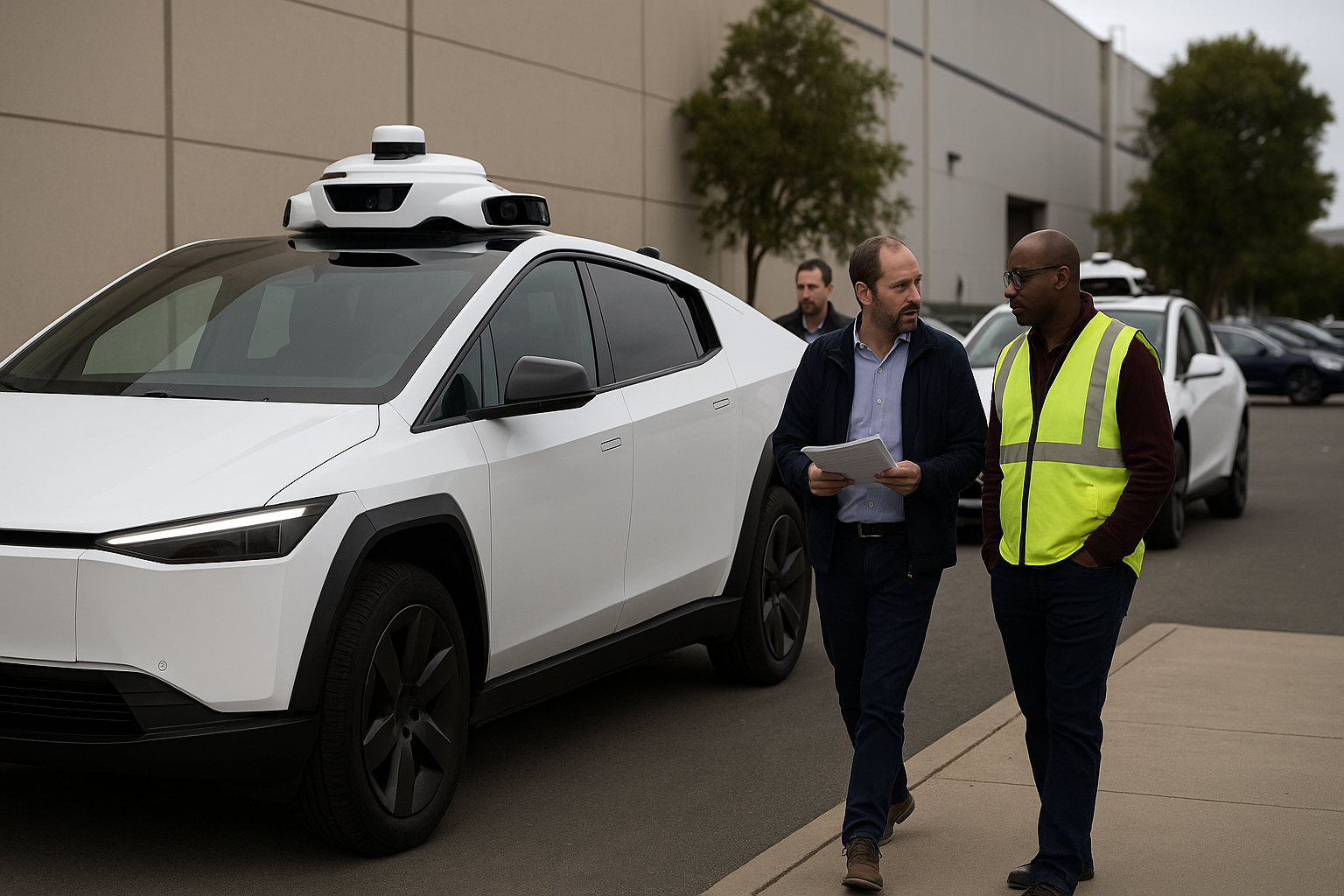
Tesla has put nearly 1,000 Cybercabs into a federal compliance audit before the public has had time to decide whether it likes riding in one. That is not a launch detail. It is the whole business model being tested. ([ca.investing.com](https://ca.investing.com/news/stock-market-news/us-auto-safety-regulator-opens-probe-into-nearly-1000-tesla-cybercabs-4828742?utm_source=openai))
On September 3, Tesla began commercial Cybercab deployment in Austin, Texas. On September 4, the US National Highway Traffic Safety Administration opened an Audit Query into Tesla’s self-certification that its new driverless vehicle meets applicable Federal Motor Vehicle Safety Standards. The Cybercab has no permanently attached steering wheel, accelerator, brake pedal or mirrors. Tesla says that is the point: it was designed for autonomy, not for a reluctant human to rescue it. ([nhtsa.gov](https://www.nhtsa.gov/press-releases/investigation-tesla-cybercab-self-certification?utm_source=openai))
Here is the blunt version: Tesla is not merely trying to prove its cars can drive themselves. It is trying to prove that it can move at software speed in a world governed by product-liability law, transport regulators and the very boring expectation that a passenger should survive the trip.
That is a much harder business than building a sexy gold two-seater.
Tesla chose the fastest legal lane — and NHTSA is checking the map
The Audit Query is not a recall, a finding of defect or a ban on Cybercab operations. Anyone telling you Tesla has already been shut down is talking rubbish. But it is an enforcement action, and NHTSA has been precise about what it wants to inspect: the process and technical data Tesla used to certify compliance, including whether Tesla determined that particular federal standards simply do not apply to a vehicle built without conventional human controls. ([nhtsa.gov](https://www.nhtsa.gov/press-releases/investigation-tesla-cybercab-self-certification?utm_source=openai))
That distinction matters.
In America, manufacturers generally self-certify that vehicles meet federal safety standards. The government does not pre-approve every car before it rolls out of the factory gate. It can investigate later, force corrective action and punish companies that get cute with the rules. Tesla has used that self-certification path for Cybercab rather than waiting for a special exemption process.
That is commercially logical. If you want to build a giant robotaxi network, an exemption capped at a small number of vehicles is not a business model. It is a demonstration. Tesla needs a route that can eventually support thousands, then tens of thousands, of vehicles without a bureaucrat approving every new batch.
But the shortcut is only smart if your legal argument survives contact with the regulator. NHTSA says existing standards remain in force while it works on rule changes related to autonomous vehicles, including standards touching pedals, windscreen wipers, lighting and rear-view mirrors. In plain English: the regulator may want autonomous transport to work, but it is not giving Tesla a free pass because the future looks shiny. ([nhtsa.gov](https://www.nhtsa.gov/press-releases/investigation-tesla-cybercab-self-certification?utm_source=openai))
This is the nasty bit founders often miss. A loophole is not the same as a durable operating permission. One gets you to launch day. The other lets you compound for a decade.
The product is a car. The wager is a network.
You can stare at the Cybercab’s missing controls all day and miss the bigger play.
Tesla is building a transport platform. Its own Robotaxi site says autonomous rides are already offered in Austin, Dallas, Houston, Miami, Orlando and Tampa, while Cybercab rides themselves are currently limited to parts of Austin. The purpose-built vehicle is a two-passenger machine intended for fully autonomous service; the existing network also uses Model Ys. ([tesla.com](https://www.tesla.com/robotaxi?utm_source=openai))
That tells you why Cybercab matters more than another vehicle launch.
A normal car company sells you a car, books the revenue and hopes you come back in a few years. A robotaxi operator owns — or orchestrates — the asset, dispatch, pricing, maintenance, charging, insurance, mapping, customer support and ultimately the passenger relationship. If it works, every ride is recurring revenue. If it scales, the operator learns which suburbs, airports, event precincts and operating hours actually make money.
That is why the steering wheel is not the real story. Removing it is a physical declaration that Tesla wants the car to belong to a fleet, not an owner.
And Tesla is already signalling that it may not intend to fund every fleet itself. Before the Austin launch, it published an interest form for businesses that may want to buy Cybercab fleets or provide mobility hubs and other infrastructure. Tesla has not committed to selling vehicles to third-party fleet operators, but the request is a loud clue: it wants help saturating markets faster. ([techcrunch.com](https://techcrunch.com/2026/09/03/tesla-is-asking-people-if-they-want-to-buy-and-run-cybercab-fleets/?utm_source=openai))
That could be powerful. It could also be a mess.
The moment third parties own or operate parts of your network, your brilliant product becomes a standards-and-operations business. Who cleans the cars? Who handles a stranded passenger? Who pays when one is damaged? Who has authority to take a vehicle offline after an incident? Who carries the insurance risk? Who answers when a city councillor, regulator or local news crew asks why a driverless car made a stupid decision outside a school?
Software people love saying they are building platforms. Then they discover platforms come with plumbing.
The overlooked risk is not the audit. It is the precedent.
Most commentary will treat this as Tesla versus the government. That is too simple.
Tesla may ultimately satisfy NHTSA. The agency itself says it supports safe autonomous-vehicle development and is actively working to modernise rules that were written for cars with humans at the controls. An audit can be the price of creating a new category, not proof the category is dead. ([nhtsa.gov](https://www.nhtsa.gov/press-releases/investigation-tesla-cybercab-self-certification?utm_source=openai))
The contrarian view is that Tesla should probably want this fight resolved properly.
If Tesla wins a clear, well-supported compliance position, it has something more valuable than a few extra rides in Austin: a template for expansion. Investors can model fleet growth with more confidence. Partners can commit capital. Cities can see a framework rather than a stunt. And rivals have to meet the same standard.
If the company loses, or has to redesign vehicles, slow deployment or seek exemptions market by market, the economics change fast. Robotaxi fantasies are full of margins calculated on vehicles working nearly all day. A delayed rollout does not merely defer revenue. It leaves the cost base running while the fleet sits around doing precisely nothing useful.
This is why regulatory execution is now product execution.
I have seen founders treat legal, compliance and government relations as a clean-up crew — the people you hire once the real work is done. That is amateur hour in any business touching money, health, transport, property or alcohol. If the government can stop your product at the gate, compliance is not overhead. It is part of the product.
Tesla’s own investor materials show why it is so determined to keep moving. By the end of June, the company reported roughly 2.4 million cumulative paid Robotaxi miles, and it has said Cybercab is expected to become the largest-volume vehicle in its fleet over time. That is a real operating base, not a PowerPoint dream. But a base is not dominance. The next phase is whether Tesla can turn a technical demonstration into repeatable, permitted and profitable city-by-city infrastructure. ([ir.tesla.com](https://ir.tesla.com/_flysystem/s3/sec/000162828026049213/tsla-20260722-gen.pdf?utm_source=openai))
What this means for you
If you are a founder, do not copy Tesla’s swagger. Copy the useful bit: identify the bottleneck that actually limits scale, then attack it before the market forces you to.
For Tesla, the bottleneck is not whether it can manufacture another electric vehicle. It is whether a purpose-built autonomous vehicle can operate legally at industrial scale. Everything else is secondary.
Use this tomorrow:
1. Write down the one external permission your business quietly depends on. It may be a payment processor, app-store policy, data licence, insurer, council permit, supplier approval or regulator. If losing it would wreck growth, it deserves board-level attention now.
2. Separate a launch from a scalable operating model. You can launch with manual work, personal relationships and heroic exceptions. You cannot build a billion-dollar company that way. Ask what must be true for your business to operate at 100 times its current volume.
3. Make compliance a design input, not a lawyer’s footnote. Tesla’s no-controls design is inseparable from its regulatory problem. In your business, the same may be true of how you collect customer data, price credit, use AI or handle refunds.
4. Watch where a company invites partners in. Tesla asking outside businesses about Cybercab fleets and infrastructure is more informative than a glossy launch video. When a company starts sharing the workload, it is telling you where the capital burden and operational complexity really sit. ([techcrunch.com](https://techcrunch.com/2026/09/03/tesla-is-asking-people-if-they-want-to-buy-and-run-cybercab-fleets/?utm_source=openai))
The smart money should not judge Tesla’s Cybercab by whether it looks futuristic rolling down an Austin street. Judge it by whether the company can turn regulatory scrutiny into a repeatable approval playbook.
Because in the end, the robotaxi winner will not be the firm with the best demo.
It will be the firm allowed to keep the cars on the road.