Tesla–SpaceX’s $3.5T Merger Talk Is Elon Musk’s Biggest Test Yet
$3.5 trillion is too big to call a synergy story. A Tesla–SpaceX merger would test whether independent boards can protect investors from Elon Musk’s empire.
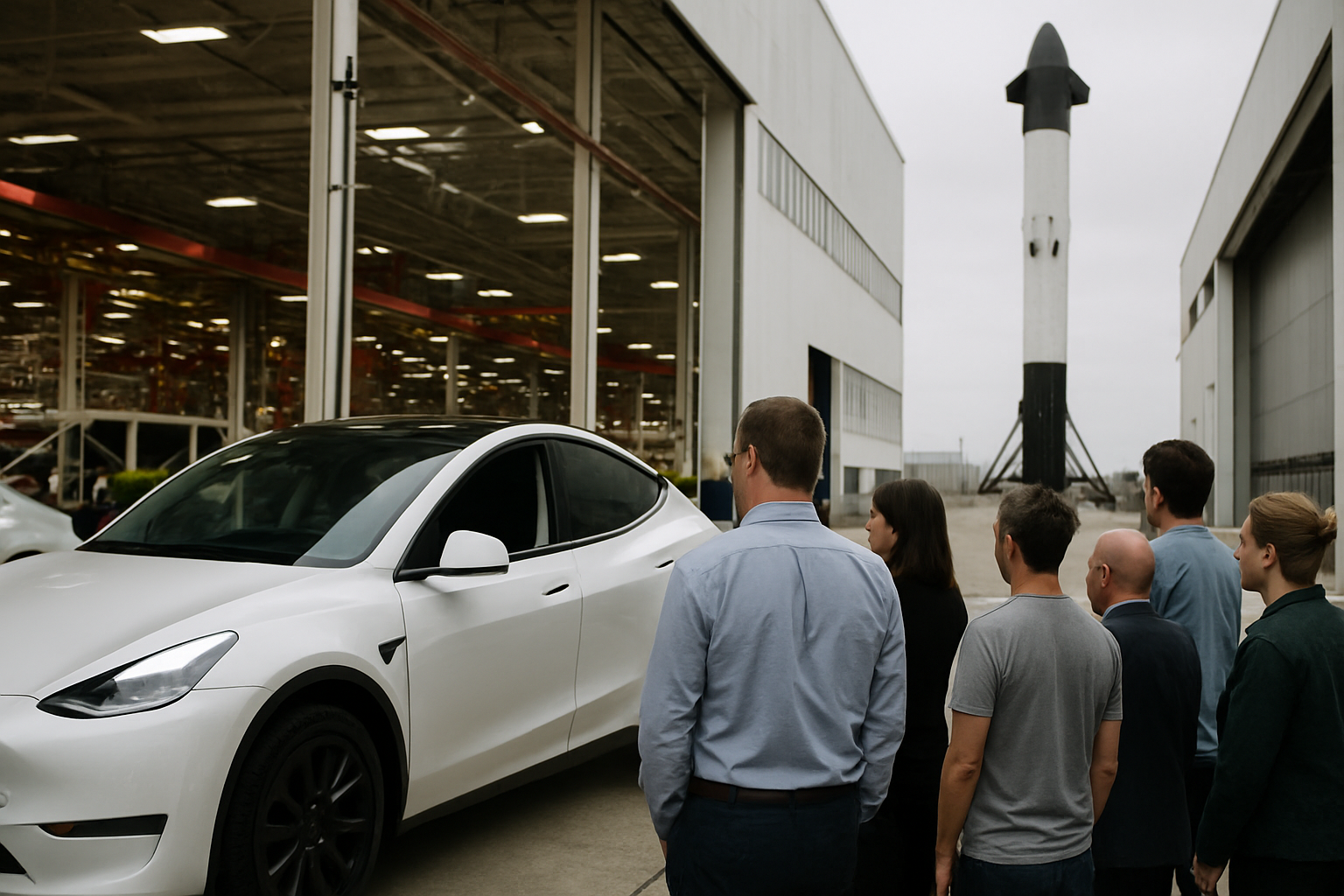
A $3.5 trillion merger does not create value just because it is enormous. It creates the largest possible opportunity for one man to shift value from the shareholders he needs least to the shareholders he controls most.
That is the uncomfortable reality behind Elon Musk confirming on October 20 that Tesla and SpaceX have formed special committees of independent directors to explore a potential merger. There is no deal, no agreed price and no timetable. But the discussion alone matters because combining the companies would put an electric-car maker, a rocket-and-satellite operator, an AI business and a chip ambition under one roof — with Musk sitting at the centre of every moving part.
Musk says he is excluded from the committee talks because he is conflicted. Good. He plainly is. The question is whether a formal process can genuinely protect Tesla shareholders when the person with the most influence over both businesses already thinks combining them is “a good idea.” ([techcrunch.com](https://techcrunch.com/2026/10/20/spacex-and-tesla-boards-form-special-committees-to-review-merger/?utm_source=openai))
The deal is not real yet. The conflict is.
Let’s not get carried away with the headline number. Axios put SpaceX at more than $2 trillion and Tesla at nearly $1.5 trillion, producing the rough $3.5 trillion figure now doing the rounds. That is not a negotiated transaction value. It is simply the scale of the two companies as the market sees them today. ([axios.com](https://www.axios.com/2026/10/20/spacex-tesla-merger-talks?utm_source=openai))
Still, scale matters. If this goes ahead, it would be a corporate monster unlike anything shareholders have had to assess before: Tesla’s public investors effectively being asked to exchange exposure to a volatile car, energy-storage and robotics company for exposure to rockets, Starlink, AI infrastructure and whatever else falls into the Musk universe next.
Musk’s strategic argument is not nonsense. He says there could be gains from working together on AI software, robotics, chips, connectivity and SpaceX’s proposed orbital data-centre project, Starmind. Tesla and SpaceX are already collaborating on chip manufacturing through the Terafab project. ([techcrunch.com](https://techcrunch.com/2026/10/20/spacex-and-tesla-boards-form-special-committees-to-review-merger/?utm_source=openai))
There may well be genuine technical overlap. Tesla needs immense computing capacity, better chips and connectivity for autonomy and robotics. SpaceX has launch capability, Starlink and an increasingly material communications business. If you were drawing a futuristic industrial group on a whiteboard after a couple of good tequilas, these businesses would sit next to each other.
But a whiteboard is not a fairness opinion.
The risk is simple: strategic logic can become a handy excuse for financial laziness. “AI,” “robotics” and “superintelligence” are not magic words that erase the need to prove who is paying what, who is receiving what and whether the exchange ratio is fair.
Tesla shareholders should care about the price, not the sci-fi pitch
Tesla shareholders are not buying a small bolt-on acquisition. They could be buying into a vastly different company, with a completely different capital profile and a business mix that is harder to value than a normal industrial group.
SpaceX’s growth case is enormous, but it is not the same asset as Tesla. Launch economics, satellite broadband, government contracts, spectrum, orbital infrastructure and AI compute do not trade or operate like vehicles, batteries and energy storage. Bundling them may create optionality. It also makes it far easier for investors to lose track of what is actually working.
Conglomerates are often sold as elegant. They are usually just complicated.
That does not mean a merger is automatically bad. It means the burden of proof needs to be brutally high. Tesla shareholders should demand a deal structure that values SpaceX conservatively enough to leave upside for both sides, rather than treating the most exciting private-market narrative as settled fact.
They should also demand clear segment reporting after any merger. Not glossy presentations. Proper numbers: capital expenditure by business, margins by business, cash burn by project, related-party transactions, debt obligations and exactly how capital gets allocated between cars, Optimus, Starlink, launch, AI and chip fabrication.
If management cannot explain that in plain English and a clean set of financial statements, it is not ready to own the thing.
“Independent” is a process, not a personality trait
Musk said the committees are made up of independent directors and that he cannot take part in their discussions. That is the right starting point. It is not the finish line.
A special committee exists to solve the central problem here: Musk is chief executive and the largest individual shareholder of both companies. He cannot negotiate against himself. So each side needs advisers, legal firepower, separate valuations and directors prepared to say no if the terms are rubbish.
The complication is that independence on paper and independence in practice are different things. TechCrunch noted that Ira Ehrenpreis holds committee leadership roles at both Tesla and SpaceX, while the eventual merger-committee memberships have not been disclosed. That does not prove wrongdoing. It does show why governance will be examined with a microscope. ([techcrunch.com](https://techcrunch.com/2026/10/20/spacex-and-tesla-boards-form-special-committees-to-review-merger/?utm_source=openai))
Here is the standard I would apply: could the Tesla committee kill the deal, publicly explain why, and remain secure in its position? If the answer is anything less than an unambiguous yes, Tesla shareholders have a problem.
Musk himself highlighted another obstacle: Tesla would need support from 50% of all shares, not merely 50% of votes cast, according to his comments on the SpaceX earnings call. That is a much tougher hurdle than most headline readers will appreciate. A deal this big cannot survive on fan enthusiasm and passive shareholder apathy. ([techcrunch.com](https://techcrunch.com/2026/10/20/spacex-and-tesla-boards-form-special-committees-to-review-merger/?utm_source=openai))
The overlooked angle: this is really an empire-design exercise
Most commentary will focus on whether Tesla gets access to SpaceX’s rocket magic. Fair enough. The more important question is what this merger says about the direction of Musk’s corporate structure.
SpaceX already acquired xAI Holdings in February 2026, making it a wholly owned subsidiary, according to Tesla’s annual filing. ([ir.tesla.com](https://ir.tesla.com/_flysystem/s3/sec/000110465926053166/tm2611837d1_10ka-gen.pdf?utm_source=openai))
That matters because it suggests the merger discussion is not an isolated thought bubble. It is part of a broader consolidation of Musk-linked assets around AI, compute, communications and physical infrastructure.
There is a sensible strategic case for this. AI needs power, chips, data, connectivity, factories and machines that can act in the real world. Tesla has manufacturing scale, vehicle data and robotics ambitions. SpaceX has launch, satellites and communications infrastructure. Put them together and you get a vertically integrated bet on the physical economy of AI.
But vertical integration has a dark side: it can hide cross-subsidies. One business can fund another. A highly valued asset can justify more capital for an unproven project. Weak performance in one division can disappear inside a bigger story about the future.
That is why I would be more interested in capital-allocation rules than the press release. How much Tesla cash can be directed to SpaceX projects? Who approves it? What return thresholds apply? Can shareholders see the internal transactions? Is there an independent capital committee with real teeth?
If the answer is vague, investors are not buying synergy. They are buying faith.
The contrarian take: a merger may be less necessary than Musk wants investors to believe
There is an easy assumption that businesses with technical overlap should be one business. I do not buy that automatically.
Tesla and SpaceX can share chip knowledge, engineering talent, AI research and supplier relationships without forcing public shareholders to own a sprawling hybrid company. Commercial partnerships can capture many of the benefits while preserving financial accountability.
In fact, keeping the businesses separate may be healthier. Separate companies create separate scoreboards. Tesla management has to answer for Tesla. SpaceX management has to answer for SpaceX. When everything sits inside one giant vehicle, the temptation is to judge the whole operation on a story instead of results.
The best case for a merger is not “these are both Musk companies.” That is the weakest case. The best case is that quantified savings, faster product development, lower capital costs and better economics outweigh the loss of focus and the governance risk.
Until the committees show that maths, this is an idea — not an investment thesis.
What this means for you
If you are a founder, this is a reminder that strategic fit is not enough. When you buy or merge, write down the numbers before you tell the story: revenue overlap, customer overlap, cost savings, integration cost, cash required and who loses if your assumptions are wrong. Excitement is free. Integration is not.
If you are an investor, learn to separate a great asset from a great transaction. SpaceX may be exceptional. Tesla may be exceptional. That does not automatically make the price or structure of a combined company exceptional. Ask what you are giving up, what you are receiving and who negotiated on your behalf.
And if you are an operator building a business, keep your scorecard clean. Partnerships can deliver plenty of upside without turning your company into an unreadable corporate octopus. Do deals when they improve the economics, not because a bigger story sounds impressive at a conference.
Musk may yet create the most consequential merger in modern corporate history. But the winner will not be decided by rockets, robots or bravado. It will be decided by the boring stuff: price, governance, disclosure and whether somebody in the room is actually willing to say no.