TMRW Sports Nears $1B: NFL Flag Football Is the Test
US$1 billion for a company with one young golf league is a rich price. TMRW Sports only earns it if the NFL’s flag football league becomes a real business.
US$1 billion for a company best known for one young indoor golf league is a rich price. TMRW Sports only earns it if it becomes far more than a bet on golf.
Tiger Woods, Rory McIlroy and former Golf Channel boss Mike McCarley have built TMRW Sports around TGL, their technology-heavy team golf product. Fair enough. Yet the thing investors are being asked to value now is broader: a machine for turning existing sports audiences, famous athletes and institutional partners into new media properties.
The most important piece of that machine is not a simulator, a giant screen or a few blokes hitting wedges indoors. It is the NFL’s new professional flag football league.
That is where the US$1 billion story gets serious—and where it can still go horribly wrong.
The jump from roughly US$500 million to US$1 billion
Front Office Sports reported this week that TMRW Sports is finalising a funding round at a valuation north of US$1 billion. That would be roughly double the valuation attached to its 2024 Series A, which was reported at close to US$500 million, and well above the US$650 million figure reported for a 2025 round.
Read that carefully: valuation, not revenue. Not profit. Not cash in the bank.
A valuation is simply the price sophisticated people are prepared to pay today for a slice of a future they believe can be much larger. Sometimes that future arrives. Sometimes everyone discovers they paid venture-capital prices for a very polished PowerPoint.
Still, this is not Tiger and Rory wandering into a room with a golf simulator and a celebrity cap table. TMRW’s investor network has always been stacked with sports ownership, media, technology and distribution muscle. Its 2024 funding included Dynasty Equity and Connect Ventures, while its wider investor base included names such as Stephen Curry, Serena Williams, Alex Morgan, Shohei Ohtani, Lewis Hamilton, Josh Allen, Kevin Durant, Dwyane Wade and Mike Trout.
That roster gets headlines. The useful part is the access behind it: owners, sponsors, broadcasters, athletes and people who know how to sell sports rather than merely talk about “fan engagement” until everyone needs a lie-down.
The new valuation says investors think TMRW can use that network repeatedly—not just once with TGL.
TGL proved there is a product. It did not prove there is a giant business.
TGL was TMRW’s first proper test. It gave PGA Tour stars a made-for-TV team format, a controlled venue, technology that looks better on a screen than a traditional four-hour golf broadcast, and an ESPN platform.
The audience data tells an honest, mixed story—which is more valuable than a fake victory lap.
Through eight matches of its 2026 season, TGL averaged 508,000 viewers across ABC, ESPN and ESPN2, according to Sports Business Journal. That was below the 643,000 average through eight matches in its first season, although the comparison was affected by scheduling: in 2026, fewer early matches ran in ESPN prime time. The league’s ESPN-only average was 615,000 viewers, marginally ahead of its 2025 ESPN average of 605,000.
Its social numbers were stronger. By that point in the season, TGL had 97.7 million social video views, above the 81.1 million it generated across all of Season 1. Its audience also skewed younger than conventional golf television: 31% of TGL’s Season 2 audience was aged 18 to 49, with a median age of 57.5, compared with a reported average PGA Tour viewer age of 63.
None of that makes TGL the next NFL. Let’s not get carried away.
But it does show TMRW can build a viable television product around a mature sport without owning the underlying sport, without buying a traditional franchise, and without waiting decades for a fan base to appear. That is a useful proof point.
The mistake would be valuing TMRW as a golf company because of it.
TGL is the showroom. The NFL flag football league is the possible factory.
The NFL has handed TMRW a much bigger lottery ticket
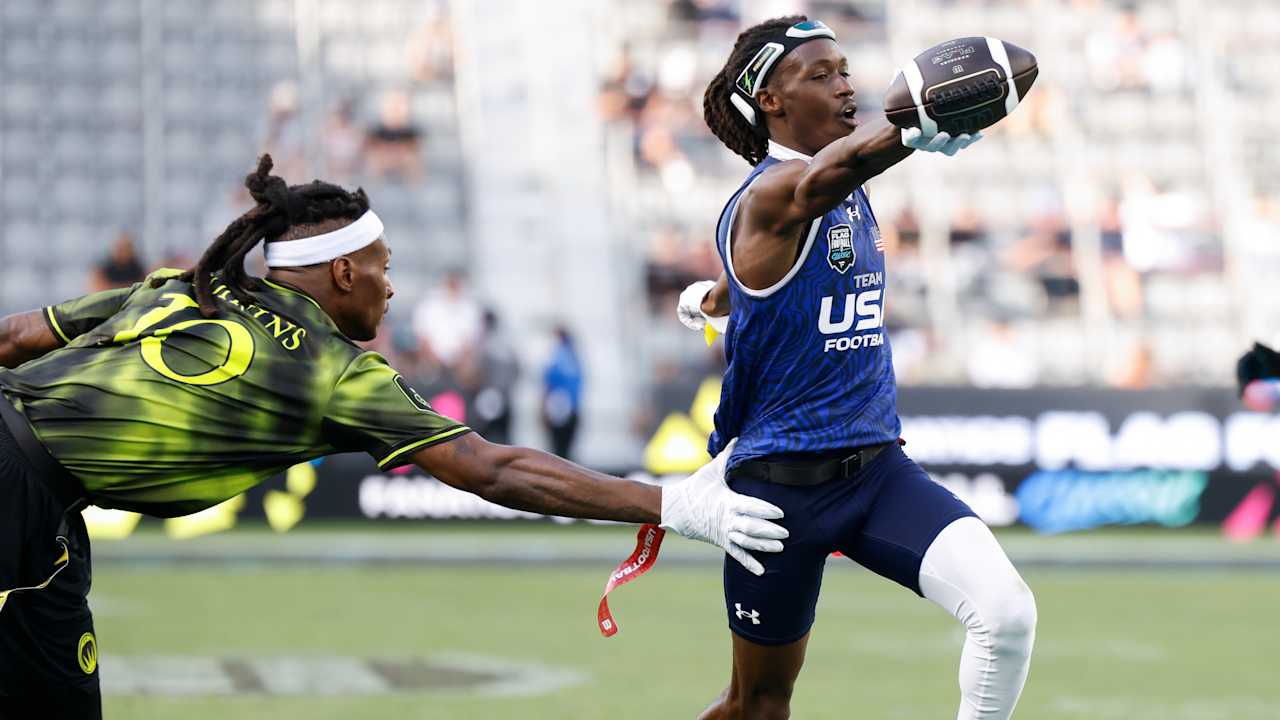
In March, the NFL selected TMRW Sports to develop and operate a professional flag football league for women and men. Every one of the NFL’s 32 clubs is behind the project through the league structure, and 32 Equity—the clubs’ investment vehicle—was authorised to invest up to US$32 million toward the league’s launch and operation.
That number is not huge by NFL standards. It is deliberately not huge. The NFL is not trying to buy a league with US$32 million. It is buying an option on a global participation sport before the rest of the market fully prices it in.
The NFL says flag football has around 20 million players worldwide. In the US, it puts youth participation at roughly 4.1 million, more than 50% higher than in 2020. Flag football is now available at high-school level in 39 states, while the number of young women playing high-school flag rose nearly 60% from 2024 to 2025.
Then comes the obvious accelerant: flag football makes its Olympic debut at the Los Angeles Games in 2028.
That creates a rare commercial set-up. The NFL owns the biggest football brand on earth. It has a sport that is cheaper, safer and easier to export than tackle football. It has an Olympic catalyst coming. And it now has an operator that has already shown it can package sport for modern broadcast and social consumption.
TMRW gets to sit in the middle of that.
The project also has heavyweight athlete backers: Tom Brady, Peyton Manning, Joe Montana, Steve Young, Larry Fitzgerald, Russell Wilson, Bobby Wagner, Arik Armstead, Alex Morgan, Serena Williams and Billie Jean King are among those named by the NFL. Again, celebrity alone does not make a business. But in a new league, distribution and credibility are half the bloody battle.
The overlooked angle: TMRW is being valued as sports infrastructure
Most people will see a golf start-up and ask whether enough people want to watch indoor golf.
Wrong question.
The better question is whether TMRW can become the operating layer for sports properties that need a modern format, a production system, commercial packaging, athlete access and an audience-growth plan.
That is a far bigger market.
Traditional sports owners have great brands but often move at the pace of a committee meeting because, well, they are committees. Start-ups can move quickly but usually lack rights, stars, trust and distribution. TMRW’s pitch is that it can bridge the two: build new products quickly while borrowing legitimacy from massive incumbent leagues.
The NFL flag deal is the clearest proof of that thesis. TMRW did not need to create demand for football from scratch. It needs to convert existing NFL equity and grassroots flag participation into a product people will watch, attend and sponsor.
That is much easier than launching another generic minor league. It is also much harder than the press release makes it sound.
A professional flag league has to answer awkward questions: Who are the stars? Will elite athletes choose it over other jobs? What does the competition format look like? Is it city-based? How much should the NFL brand sit over it? Will broadcasters pay for rights before the Olympics, or wait to see whether LA 2028 creates real household names?
And here is the nasty bit: the NFL is brilliant at making the NFL feel essential. It is not automatically brilliant at making adjacent products essential. Ask any founder who has tried to sell a product through a giant partner: access is wonderful, until the partner changes priorities.
Why the US$1 billion valuation is both smart and dangerous
The bull case is straightforward. TMRW has an unusually strong founder group, a credible first product, a growing platform in golf, a new women’s golf venture, an NFL partnership and access to capital and talent most sports start-ups would kill for. If it becomes the preferred builder of next-generation leagues, US$1 billion could look cheap in hindsight.
The bear case is just as simple. TGL’s television audience is respectable, not dominant. A new funding round does not prove repeatable economics. The NFL flag league is early, and “aligned with the run-up to 2028” is not a launch plan, a media-rights deal or a P&L.
That is the distinction smart operators must keep making: strategic momentum is not operating performance.
I like the TMRW bet because the company is not trying to out-NFL the NFL or out-PGA the PGA Tour. It is using entrenched sports brands as raw material for newer products. But the valuation only holds if management turns that access into boring things investors eventually demand: recurring revenue, disciplined costs, sponsor renewals, rights value and fans who come back without being bribed by novelty.
That is where the real work starts.
What this means for you
If you are a founder, investor or operator, nick the useful lesson—not the celebrity fantasy.
First, build beside an existing giant, not blindly against one. TMRW’s best asset is not a simulator. It is permission to build with the PGA Tour and the NFL. Find a partner with distribution, trust or customers you cannot afford to acquire yourself.
Second, do not confuse audience with business. TGL’s social views are encouraging. But views only matter if they improve sponsorship pricing, subscriptions, ticket demand, merchandise, customer data or future rights value. Make your scoreboard commercial, not just popular.
Third, take cheap options on structural change. The NFL’s US$32 million commitment is small relative to the opportunity if flag football becomes a global Olympic sport with a real professional pathway. You do not need to bet the company every time. You do need to notice when the downside is capped and the upside has a tailwind.
Finally, remember this: TMRW Sports is being rewarded for building a platform before it has fully earned the right to call itself one. That can be brilliant. It can also be expensive.
The winners will be the people who enjoy the story, then insist on the numbers.