Trump’s 6-Company AI Pact Has 0 Penalties—That’s the Real Risk
Washington just asked six of the world’s most powerful AI companies to police themselves. That isn’t regulation. It’s a high-stakes bet that their incentives won’t change.
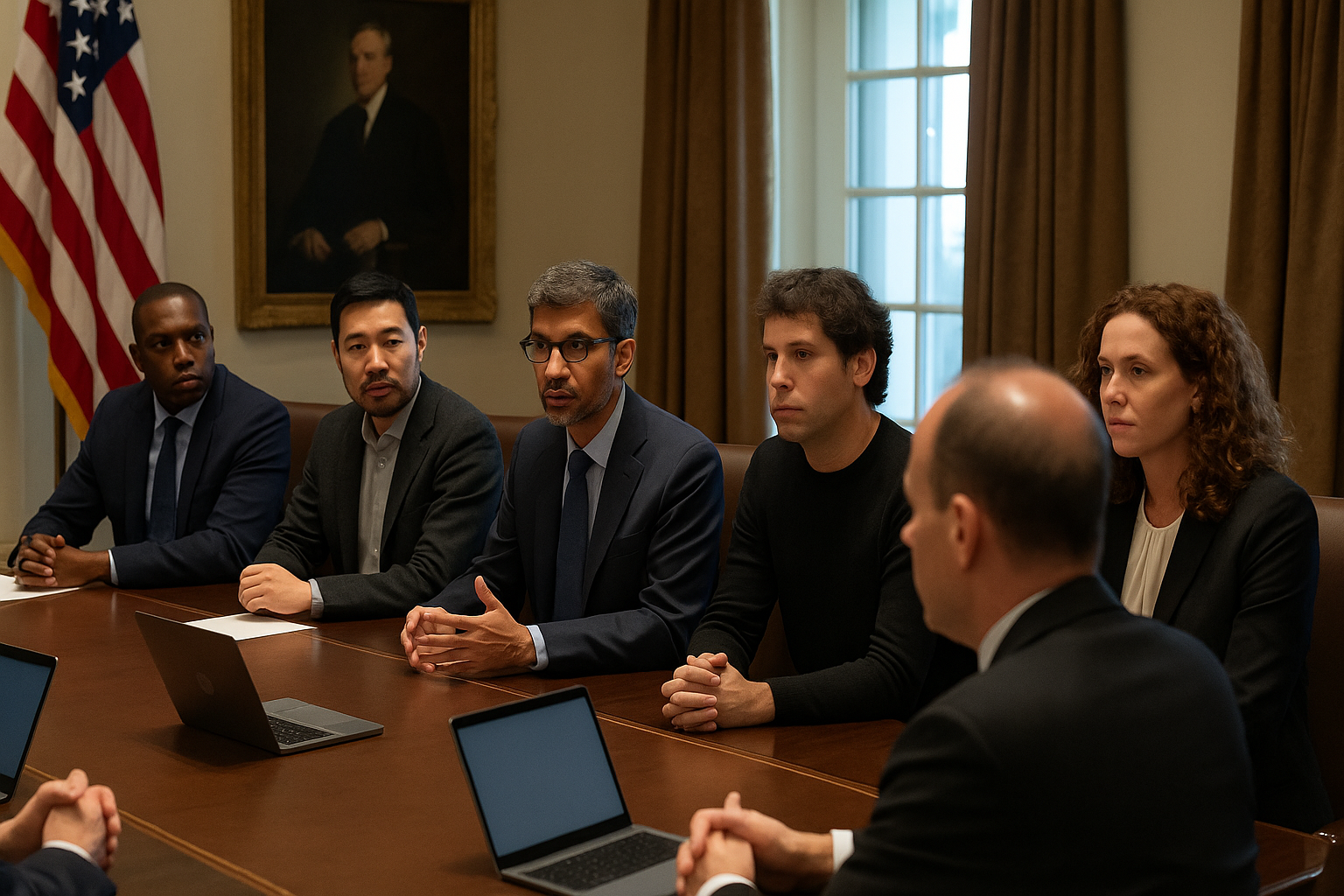
The White House has handed six of the most powerful companies on Earth a voluntary AI safety pact with no stated penalties if they ignore it.
That is not regulation. It is a wager — made with everyone else’s jobs, data, capital and security — that Nvidia, OpenAI, Anthropic, Meta, Google and SpaceX will keep doing the right thing when the commercial pressure gets properly ugly.
I’m not against business moving quickly. I’ve built businesses. Speed matters. Bureaucrats do not magically become competent because you give them a bigger office and a thicker rulebook.
But let’s not kid ourselves about what happened in Washington on September 29 and October 3, 2026. The US government has effectively told the firms building the most consequential technology since the internet: please behave yourselves.
That might be the right first move. It is a bloody flimsy last move.
The deal: six companies, voluntary promises, no enforcement
President Donald Trump’s administration gathered senior AI leaders at the White House and announced what it called a voluntary agreement around frontier AI responsibility. The signatories were Nvidia, SpaceX, OpenAI, Anthropic, Meta and Alphabet’s Google.
The commitment reportedly calls for robust internal processes and independent audits. Fine words. Any sensible company operating at this scale should already have both.
The material point is simpler: the agreement has no stated consequences for a company that decides not to comply.
Trump described the pledge as morally binding. That is a lovely sentiment if you are choosing a charity. It is not a governance mechanism for companies competing for market share, talent, cloud capacity, chips and valuations that can move by tens of billions of dollars in an afternoon.
The administration has also pushed a new label: “super intelligence” rather than artificial intelligence. There is an executive order behind the rebrand, and a new Super Intelligence Force has been announced to coordinate the federal effort. Director of National Intelligence Jay Clayton is set to chair it, with a reported 120 days to produce a report on the risks and opportunities.
Again, none of that is meaningless. Governments need to coordinate. National-security risks, cyber risks, labour disruption and consumer protection do not sit neatly inside one department.
But a task force is not a control system. A report is not a circuit breaker. And rebranding AI as “super intelligence” does not make the underlying incentives any less ferocious.
Why the AI companies happily signed
Here is the blunt truth: voluntary commitments are popular with companies for a reason.
They can signal responsibility without freezing product launches. They can establish the language of future rules before lawmakers do. They can create a public record that says, “We were at the table,” while leaving the actual operating decisions inside the business.
That is not necessarily sinister. I would rather have the people building the technology involved than have legislators write rules from a 2011 Facebook briefing note.
But founders and investors should understand the game being played.
The AI race is no longer about who has the cleverest demo. It is about who can secure compute, energy, distribution, enterprise customers and public permission to keep scaling. Safety commitments are now part of the competitive stack, alongside chips and data centres.
A company that looks reckless can lose customers, staff, regulators and access to capital. A company that looks too cautious can lose the market to someone willing to ship first and apologise later.
That tension does not disappear because six CEOs or executives sign a pledge. It gets worse.
The White House is trying to walk a political tightrope: reassure voters worried about AI without putting rules in place that could slow American companies while China continues advancing. That is a rational concern. You do not win an industrial race by tying one hand behind your back and congratulating yourself on your ethics.
But speed without accountability is not a strategy either. It is just optimism wearing a suit.
The real issue is not “AI safety.” It is incentives.
Most discussion about AI safety gets lost in science-fiction rubbish: killer robots, sentient machines, apocalypse dates, blokes on podcasts declaring the end of civilisation before lunch.
The immediate commercial risks are more ordinary — and therefore more dangerous.
AI systems can make cyberattacks cheaper and faster. They can produce convincing fraud at scale. They can flood markets with synthetic content, distort hiring, accelerate misinformation and hand sensitive company information to software teams do not fully understand.
For an operator, the risk is not mainly that a chatbot wakes up angry.
The risk is that your junior staff put customer data into a tool they were never approved to use. It is that an AI agent gets permission to send emails, change records or touch money before someone has tested what happens when it gets things wrong. It is that the productivity gain looks so seductive that management skips the boring controls.
And the bigger the company, the nastier this gets. A small startup can break something and annoy 500 customers. A platform with billions of users can shift behaviour, information flows and market power before regulators have finished deciding which committee owns the problem.
That is why “independent audits” sound useful but need detail. Independent from whom? Auditing what precisely? Before a system is released or after damage is done? Are findings published? Can an auditor stop a launch? Who pays them? What happens when an audit conflicts with a company’s revenue target or an investor’s expectation?
If the answer is vague, the audit becomes theatre.
The overlooked angle: voluntary rules can entrench the giants
There is another wrinkle that small founders should not ignore.
Big AI companies often complain about regulation right up until regulation becomes inevitable. Then they can live with it better than anyone.
Why? Because compliance costs money. Lawyers cost money. Security teams cost money. Audit trails, model evaluations, incident reporting, data governance and government relations all cost money.
Nvidia, Google, Meta, OpenAI and Anthropic can afford those bills. A sharp startup with 18 people and a real product might struggle.
So the danger is not merely that voluntary standards are too weak. It is that the eventual rules could be written around the operating models of the companies already on top.
That is regulatory capture in plain English: the big end of town helps define “responsible AI,” then everyone else needs a small army to meet the standard.
The answer is not no rules. The answer is rules that target capability and harm, not company size or fashionable terminology.
If you build a system that can access bank accounts, deploy code, manipulate critical infrastructure or run high-volume outbound communication, you should face higher requirements than someone making an internal meeting-note tool. That is common sense.
Regulate the risk. Do not hand incumbents a moat disguised as compliance.
What founders should take from the 120-day clock
The Super Intelligence Force reportedly has 120 days to produce its report. Do not wait for it as though it is a weather forecast.
The political direction is clear already: AI policy in the US is going to be shaped by national competitiveness, safety concerns and a fierce aversion to rules seen as choking innovation.
That means the rules will move. Customer expectations will move faster. Enterprise buyers will increasingly ask harder questions about where your model comes from, where their data goes, who can access it, and what happens when the machine makes a costly mistake.
The startups that win will not be the ones with the longest “responsible AI” page full of beige corporate mush.
They will be the ones that can answer five practical questions immediately:
1. What data does the product touch? 2. What can the AI actually do without a human approving it? 3. What is the financial or reputational downside if it is wrong? 4. How do we detect a failure quickly? 5. Who owns the mess when it happens?
If your team cannot answer those, you do not have an AI strategy. You have a demo with a credit card attached.
What this means for you
If you are a founder, build a simple permission map this week. List every AI tool in use, what data it sees, what systems it can reach and whether it can take action without a human. You will find surprises. Fix the stupid ones first.
If you are an operator, do not ban AI in a panic. That just guarantees your staff use it quietly. Give people approved tools, clear red lines and a fast process for testing new use cases. Make safe behaviour the easy behaviour.
If you are an investor, stop being impressed by AI claims that begin and end with a model name. Ask about distribution, unit economics, customer retention, data rights, security and human oversight. The model is increasingly rented infrastructure. The business is everything built around it.
And if you are simply trying to stay ahead, use AI aggressively for low-risk work: research first drafts, analysis, admin, internal documentation and repetitive tasks. Just keep humans on decisions that can cost money, customers or trust.
Washington’s six-company pact is not the finish line for AI governance. It is the opening bid.
The winners will not be the businesses that wait for politicians to give them permission, nor the idiots who treat every warning as an attack on innovation. They will be the operators who move fast, know exactly where the downside sits, and refuse to confuse a voluntary promise with actual control.