Tyson Foods’ $2B Test: Jeff Schomburger Replaces a 43-Year Insider
Tyson Foods runs a 133,000-person protein machine on a 3.9% adjusted operating margin. Jeff Schomburger now has a $2 billion test: make that scale earn more.
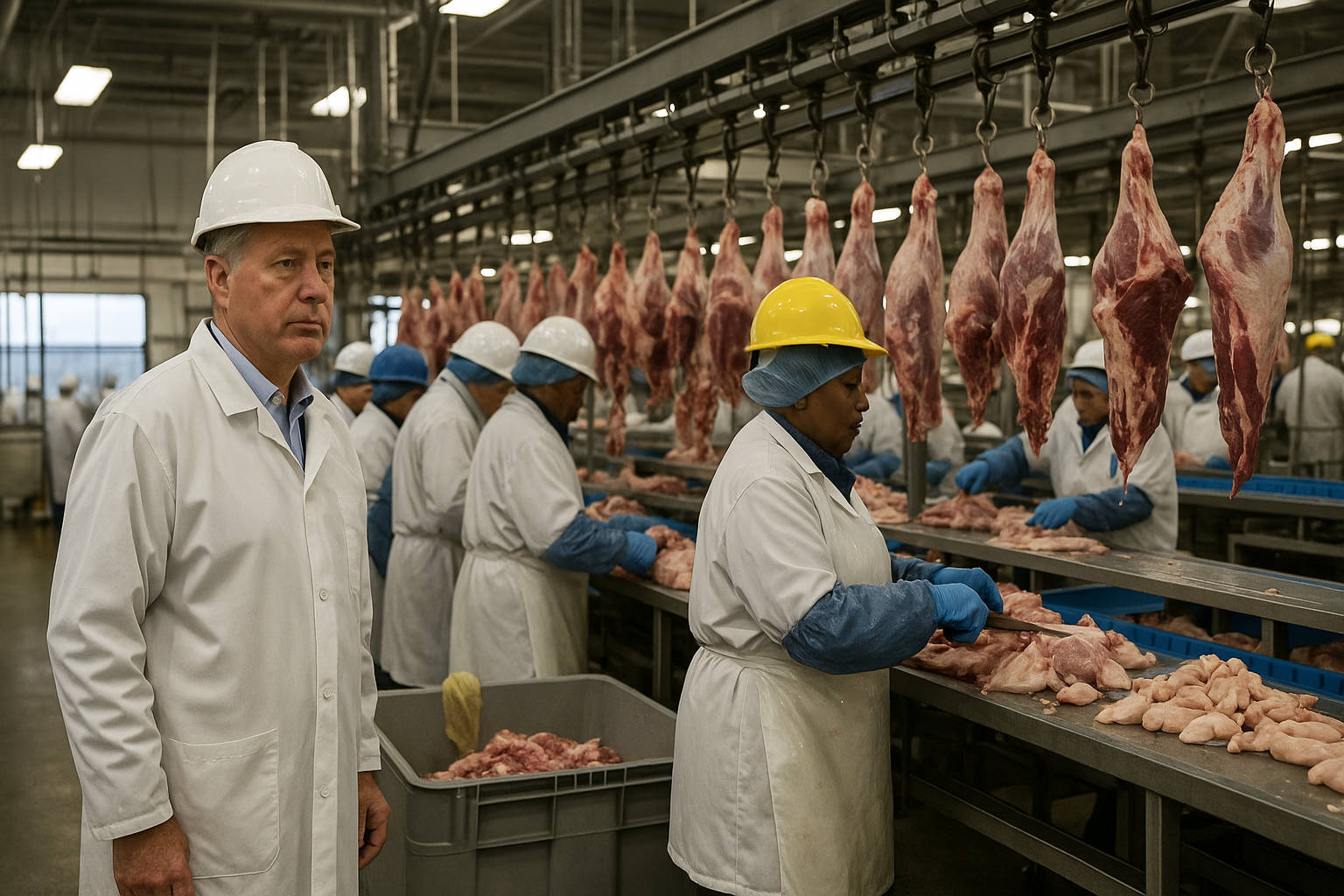
Tyson Foods runs a 133,000-person protein machine on a 3.9% adjusted operating margin. It has put a bloke from Procter & Gamble in charge and set a $1.85 billion to $2.05 billion adjusted operating-income target.
As of October 4, Jeff Schomburger is president and chief executive of Tyson Foods, replacing Donnie King after King’s 43-year career at the company. Tyson is not bringing in a random outsider with a glossy PowerPoint and a consulting vocabulary problem. Schomburger has sat on Tyson’s board since 2016, chaired its Strategy and Acquisition Committee since 2021, and served as lead independent director since 2025.
Still, the appointment matters because he is not the usual succession choice for a massive food manufacturer. Schomburger spent 35 years at Procter & Gamble, finishing as global sales officer. Tyson’s board has effectively said the next phase is less about knowing every corner of a processing plant and more about winning at the shelf, with customers and in consumers’ heads.
That is a serious bet. Tyson’s updated fiscal 2026 outlook calls for $1.85 billion to $2.05 billion in adjusted operating income. This is not a ceremonial CEO handover. Schomburger inherits a large, complicated machine with meaningful momentum, thin margins by normal business standards, commodity exposure, regulatory risk and customers powerful enough to make a supplier sweat.
The job is not to preserve Tyson. It is to sharpen it.
Donnie King leaves Schomburger a business that has done real work to improve its operating discipline. In Tyson’s third quarter, the company reported sales of $13.868 billion and adjusted operating income of $547 million. Chicken and Prepared Foods were the standout segments, while Tyson said Chicken had delivered seven consecutive quarters of growth and its branded products continued gaining market share.
That is the good news.
The less comfortable truth is that Tyson still produced an adjusted operating margin of 3.9% in that quarter. A business can move an extraordinary amount of product, employ roughly 133,000 people and own household brands including Tyson, Jimmy Dean, Hillshire Farm, Ball Park and State Fair—then still have very little room for sloppy management.
At a 3.9% adjusted operating margin, a bit of waste is not a harmless operational nuisance. It is the difference between a decent year and a board asking hard questions. Bad procurement, poor plant execution, price increases customers refuse to wear, weak promotional discipline, or a product mix that drifts toward lower-value volume: each can chew through profit quickly.
This is why I like the basic logic of the appointment. Tyson does not need a CEO who walks around saying “protein” 40 times a day as though he invented chicken. It needs someone who understands customers, category management, brands, sales execution and the brutal maths of getting more value from the same consumer relationship.
Schomburger’s P&G experience will not automatically make him right. Consumer packaged goods and animal protein are different games. But it is relevant experience for a company trying to turn a massive production footprint into stronger, more defensible branded earnings.
Tyson is making an outsider appointment without taking an outsider gamble
The clever bit is the way John H. Tyson and the board structured it.
Schomburger is an operational outsider but an institutional insider. He has spent a decade on the board. He has worked on compensation, audit and strategy matters. He has been close to King and management. He knows the board’s priorities, the company’s capital-allocation debates and the ugly bits that never appear in an investor presentation.
That should reduce one of the dumbest risks in CEO succession: hiring somebody who needs 18 months to learn where the bodies are buried. By then, the market has usually worked out whether the new leader is serious, and the organisation has had plenty of time to test whether it can wait the person out.
Tyson instead gave Schomburger a transition period beginning in July before he assumed the job on October 4. King remains on the board and is expected to assist with the transition over the coming months. That continuity is useful, provided it stays continuity and does not become dual command.
This distinction matters. A former CEO on the board can be a valuable source of context. He can also become a human handbrake if executives keep wondering whose view is the real view. Schomburger needs the benefit of King’s company knowledge without running a shadow administration. Boards need to be ruthless about that line, because polite ambiguity at the top becomes political paralysis everywhere else.
The $2 billion target is not the real test
The headline number is Tyson’s adjusted operating-income range of $1.85 billion to $2.05 billion for fiscal 2026. It gives investors something to model and executives something to organise around.
But the proper test is whether Schomburger can improve the quality of Tyson’s earnings.
A food company can lift profit for a while through price, commodity cycles or a temporary cost squeeze. Good luck building a durable business on any of those. What lasts is better mix, stronger brands, customer relationships that produce repeatable distribution, less operational waste and capital spending that earns more than it costs.
Tyson expects fiscal 2026 sales growth of 1.5% to 2.0% and capital expenditure of $700 million to $900 million. Those figures tell you the task is not simply “grow faster.” The task is to make sure every dollar of spending, every plant improvement and every bit of shelf space produces a better economic outcome.
That is where a sales-led consumer operator can earn his keep. The point is not to turn Tyson into P&G with chicken nuggets. That would be absurd. The point is to bring harder commercial thinking to a business where operational scale has historically been the centre of gravity.
In plain English: Tyson needs to sell more valuable food, not merely more food.
The overlooked angle: this is a board succession story
Most CEO coverage treats the chief executive as the only character worth watching. That is lazy.
The more interesting story is what Tyson’s board has revealed about its own view of the company’s next decade. John H. Tyson, the chairman and grandson of the founder, had the option of choosing another deeply embedded food-industry executive. Instead, the board selected a director whose career was built in consumer brands and global sales.
That says the board believes commercial execution now deserves the same weight as industrial know-how.
It also says Tyson has done something many boards are hopeless at: it planned ahead. Schomburger was named in May, given a multi-month transition, and has years of board-level familiarity with the company. There is no emergency appointment, no interim title, no theatre about a “comprehensive search” after somebody bolts.
That should be normal. It is not.
Too many boards only discover succession planning is important when the CEO gets sick, gets pushed out, stuffs up or announces retirement with a golf bag already in the boot. Then they hire a search firm, produce flattering biographies and pretend the lack of preparation was a strategy.
Tyson’s approach is more boring than that. Good. Boring succession is usually the profitable kind.
The risk Schomburger must avoid
The temptation for any incoming CEO is to arrive with a grand diagnosis. New strategy. New values. New operating model. New posters. New corporate language nobody asked for.
That is how good businesses get distracted.
Schomburger should spend his early months making a handful of clear calls. Which brands deserve disproportionate investment? Which customer relationships can grow profitably? Where is complexity eating margin? Which capital projects genuinely raise returns? Where are the decision bottlenecks? And which targets are creating volume for the sake of volume?
He should not confuse activity with transformation.
Tyson already has scale, brands and a broad portfolio. Its third-quarter results showed genuine strength in Chicken and Prepared Foods. The incoming CEO’s job is to make those advantages compound. If he can improve the company’s commercial discipline while preserving its operating edge, the profit target will take care of itself.
If he spends two years reorganising boxes on an org chart, it will not.
What this means for you
Whether you run a startup, a family business or a division inside a big company, there are three useful lessons here.
First: succession is a business system, not an HR event. Identify plausible successors before you need one. Give them exposure to customers, strategy, capital decisions and difficult operational realities. The right successor should not be discovering the business on day one.
Second: hire for the next bottleneck, not the last success. Tyson did not choose Schomburger because P&G experience is fashionable. It chose him because the business now needs more commercial firepower alongside its industrial capability. Ask yourself what is actually constraining your company: product, sales, cash, talent, execution or leadership depth. Then build around that.
Third: make transition authority painfully clear. Keep the outgoing leader close enough to transfer judgment, but not so close that everyone waits for permission from the old boss. One leader owns the decision. Everybody needs to know who that is.
That is the real lesson from Tyson Foods. Big businesses do not usually fall apart because there was no strategy document. They lose ground because nobody made the next leadership decision early enough—or clearly enough.
Schomburger now gets the chance to prove that commercial discipline can make a protein giant more valuable. For Tyson’s board, the wait is over. For the new CEO, the easy bit was getting the title.