US 10-Year Treasury at 5.20%: The Bond Market Just Raised Everyone’s Costs
A 5.20% US Treasury yield is not a bond-market footnote. It is a global price rise for mortgages, startups, shares and every business pretending cheap money is coming back.
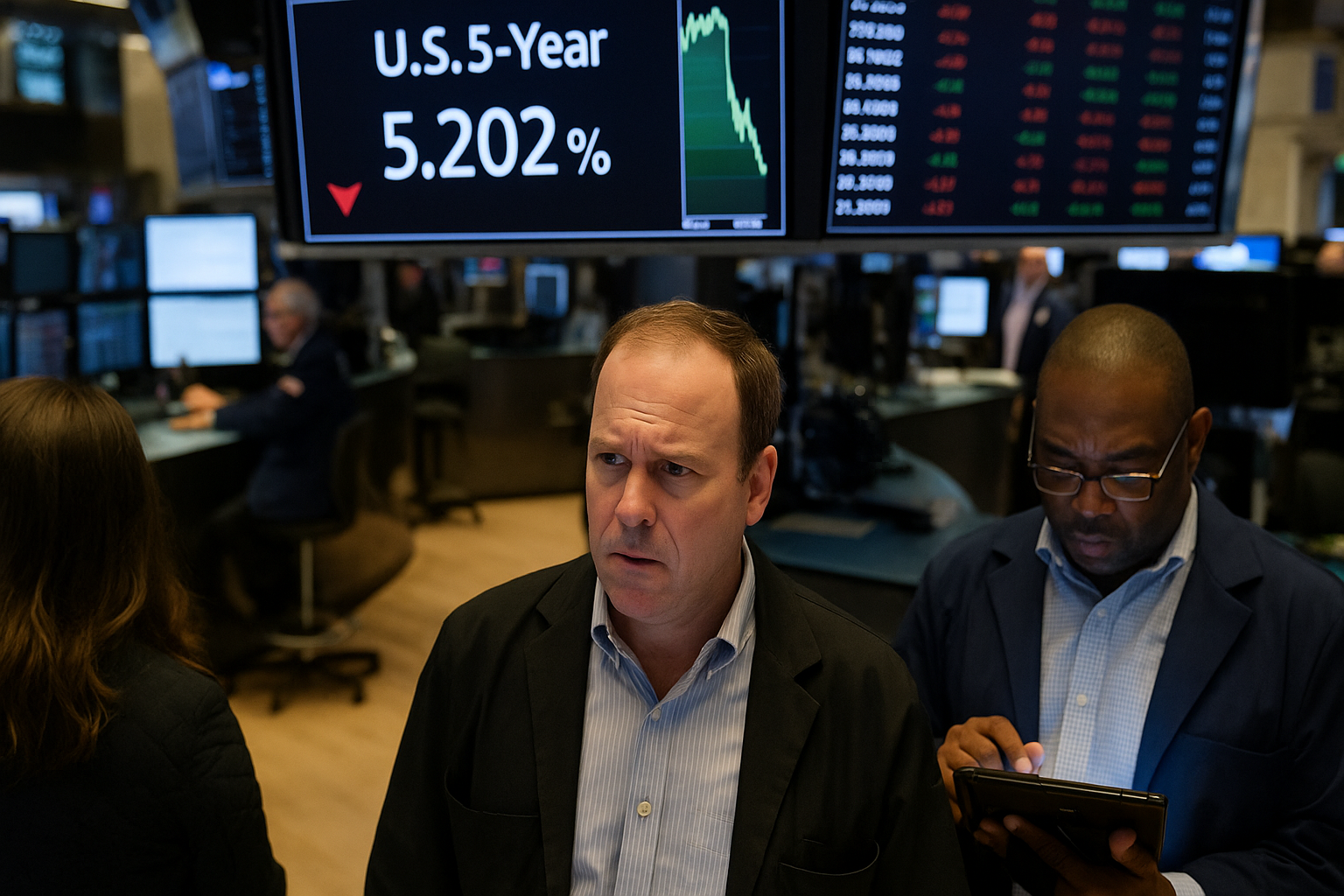
The US 10-year Treasury yield hit 5.196% on September 24, its highest level since 2007. If your business plan, property portfolio or share portfolio needs rates to fall to work, you do not have a plan. You have a prayer.
That is the uncomfortable message from the bond market this week. While plenty of investors were busy staring at the next AI winner or arguing about whether stocks can keep climbing, the supposedly boring end of finance was getting properly ugly. The US 30-year Treasury yield rose above 5.46%, its highest level since 2004. The 10-year briefly touched 5.2251%, following a roughly 20-basis-point jump in two days.
That matters because US government bonds are the reference price for money. When that reference price rises, every other price gets repriced eventually: home loans, car finance, private equity deals, venture debt, corporate borrowing, infrastructure projects and the valuation of businesses whose profits live somewhere off in the distant future.
The trigger was not mysterious. Oil moved back above US$100 a barrel, Brent traded near US$105, and markets started taking seriously the prospect that the Federal Reserve will need to keep lifting rates after its first increase in more than three years. Reuters reported that futures markets put the chance of another Fed hike next month at 71% as of September 24.
The old investor fantasy was that inflation would fade, the Fed would relax, yields would fall and asset prices would get another shot of rocket fuel. This week, the bond market told that fantasy to get stuffed.
Oil is not just an energy story
A Houthi missile attack on Saudi Arabia revived fears of further supply disruption, pushing oil up about 3% on September 24. Reports of potential US-Iran discussions around reopening the Strait of Hormuz pulled prices around during the day, but that volatility is the point. Business cannot sensibly budget around a commodity that can leap several dollars in minutes because one geopolitical headline lands.
The market’s concern is not simply that petrol gets dearer. Expensive energy leaks into everything: freight, manufacturing inputs, airline tickets, logistics, construction, food distribution and household budgets. It is an inflation tax that arrives without asking permission.
And inflation is particularly nasty when growth is still holding up. A weak economy gives central banks an excuse to cut. A resilient economy with higher input costs gives them a reason to stay restrictive or tighten further.
That is exactly the bind investors are now pricing. September’s US business-activity data came in stronger than expected, while businesses reported input-price pressure at close to four-year highs. New York Fed President John Williams described the US economy as showing “remarkable resilience” and the labour market as solid. Great for the economy in a vacuum. Less great if you are waiting for the central bank to rescue your overleveraged deal.
This is why the bond sell-off has teeth. It is not one scared trader dumping paper. It is a market looking at stronger activity, more expensive oil, heavy government borrowing and massive corporate spending on AI infrastructure, then demanding more compensation to lend money for 10 or 30 years.
Fair enough, frankly.
The 5% line changes the maths
People get far too emotional about round numbers in markets, but 5% on the US 10-year Treasury is not just a psychological line. It changes the competition for capital.
For years, investors were forced out the risk curve because safe government debt paid bugger-all. That helped lift the value of growth shares, speculative technology, property, private credit and businesses with vague promises attached to 2030 revenue forecasts.
Now a risk-free US government bond offers a yield above 5% at the long end. That does not mean equities automatically collapse. It does mean every risky asset has to make a better case for itself.
A company trading at a heroic valuation must now prove that future earnings will be genuinely exceptional, not merely better than average. A property buyer has to contend with much higher financing costs. A founder raising capital needs to understand that investors can get paid properly without taking a punt on a business with no pricing power and a slide deck full of optimism.
That is a healthier environment, even if it is painful.
The Bloomberg market wrap from September 24 captured the immediate effect: the S&P 500 erased its gain for the month as oil and bond volatility made traders less willing to make riskier bets. Chipmakers fell, the dollar strengthened, and the market began reflecting three Fed hikes over the following year.
The important bit is not whether shares finish up or down on any given Thursday. It is the new hurdle rate. When the hurdle rate rises, weak businesses do not merely become less fashionable. They become unfinanceable.
The overlooked problem is government borrowing
Oil is the headline because it is dramatic. A missile attack and US$105 Brent make for a tidy news story. But the more durable issue is the amount of debt governments need markets to absorb.
Investors are not only worried about inflation. They are also asking how much new government debt is coming, who will buy it, and what yield they need before they are willing to lock in money for decades.
That matters because the United States is not operating in isolation. Reuters reported that Germany’s 10-year Bund rose above 3.6% this month, its highest level in 17 years, while Japan’s 10-year government-bond yield reached 3.115%, its highest since 1996. This is a global repricing of long-term money, not a small American tantrum.
When long bonds sell off across major economies, governments face a nastier refinancing bill. That creates pressure for either more borrowing, more taxes, less spending or some unpleasant cocktail of all three. None of those outcomes is brilliant for asset prices.
The contrarian point is this: the bond market is not necessarily forecasting a recession tomorrow. It may be saying something worse for asset owners — that nominal growth can remain decent while money stays expensive.
That is the regime many investors have not properly modelled. They know how to invest in boom times. They know how to hide in a recession. Fewer know how to operate when demand is resilient, inflation keeps flaring up and capital costs enough to matter.
Why AI does not get a free pass
There is a popular view that the AI investment boom makes all this irrelevant. Corporate profits are strong, data centres are being built, and productivity gains will eventually justify the spend.
Maybe. But “eventually” is where people lose their trousers.
AI investment is capital-intensive. Data centres, chips, electricity, cooling and network infrastructure require real money now. If bond yields stay elevated, the cost of funding that build-out rises just as investors become more selective about which projects can produce actual cash returns.
The winners may still win spectacularly. But the gap between businesses with cash flow and businesses with vibes will get wider.
That is not anti-technology. It is pro-arithmetic. I build businesses, and I like big ambitions. But I have also learned that a brilliant market story does not pay interest expense. Cash flow does.
Founders should take this as a useful warning. If your model only works when money is cheap, customers are forgiving and investors are desperate to deploy capital, then the model was never robust. It was subsidised by a particular mood in financial markets.
What this means for you
First, stress-test your finances at higher rates, not lower ones. If you own property, run a business or hold debt, model what happens if borrowing costs stay elevated for another 12 to 24 months. Do not use the friendliest refinance assumption and call it strategy.
Second, separate long-duration hope from present-tense cash generation. In your portfolio and in your business, ask a brutally simple question: what produces cash today, and what merely promises it later? Both can have value, but they should not be priced the same.
Third, protect optionality. Keep cash. Extend debt maturities before you desperately need to. Cut vanity spending. Make sure your business can survive a slower customer, a more cautious lender and a more demanding investor. Optionality is not sexy. Neither is being forced to sell a good asset at a stupid price.
Finally, stop waiting for central banks to make life easy. The Fed may cut eventually, or it may hike again if oil and inflation keep misbehaving. Either way, building your financial life around a forecast from someone in a suit is a poor substitute for building margin into the numbers.
The bond market has delivered the message: money is expensive again. The smart response is not panic. It is to become the sort of operator who can make money when it stays that way.