U.S. 30-Year Treasury: 55 Days Above 5% Is Everyone’s Problem
The bond market is charging America more than 5% to borrow for 30 years—and most founders are still acting like money is cheap.
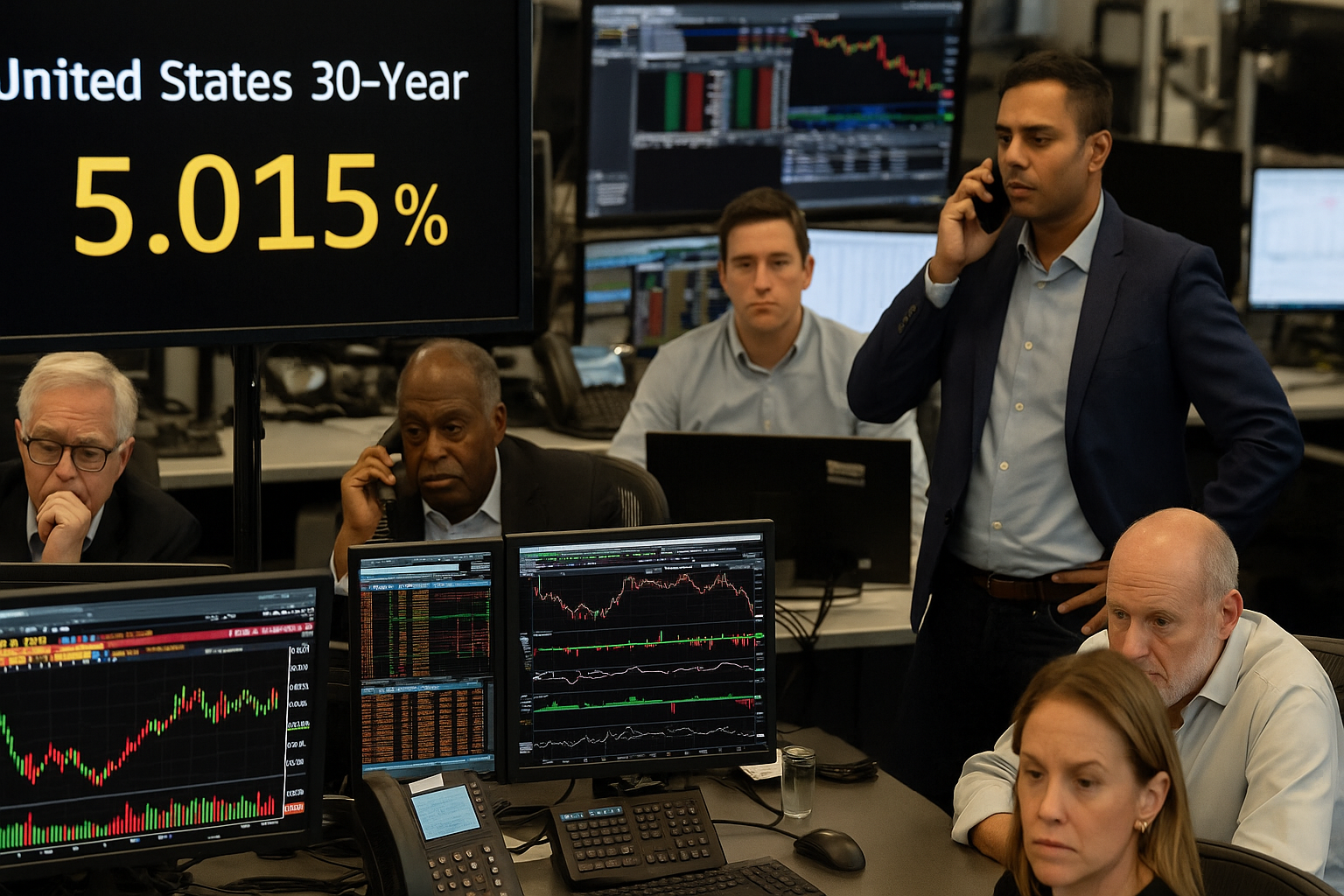
The bond market is charging America more than 5% to borrow for 30 years—and most founders are still acting like money is cheap.
That is how people get caught with their trousers around their ankles: not by a dramatic crash, but by continuing to make 2021 decisions after the price of capital has changed.
The number that should make operators uncomfortable
The U.S. 30-year Treasury yield has finished above 5% on 55 days since January 1. That is the most such days in a year since 2006. It hit 5.34% in mid-August, its highest level since 2007, and was around 5.28% on September 1.
Most people hear that and think: bond nerd stuff. Pension funds. Bloomberg terminals. Blokes in red braces arguing about duration.
Wrong.
The 30-year Treasury is one of the prices underneath nearly every serious financial decision. Mortgage rates, commercial-property loans, infrastructure finance, private-credit returns, corporate borrowing costs and valuations all take their cues—directly or indirectly—from the risk-free rate over time.
When the U.S. government has to offer more than 5% for 30-year money, everybody else has to look more attractive than the U.S. government. That means they need to pay more, promise more growth, or accept a lower valuation. Usually, it is a nasty combination of all three.
The 10-year Treasury yield closed September 1 at roughly 4.8%, a 19-month high. The two-year yield was about 4.35%, up materially from the start of the year. This is not one corner of the bond market having a sook. The entire cost-of-money structure is repricing.
Oil lit the match. The debt pile supplied the fuel.
Renewed U.S.-Iran hostilities have pushed fresh concern into energy markets. Brent crude rose above $92 a barrel on September 1 and extended higher in early Asian trading on September 2, reaching about $95.34.
Oil is not merely a petrol-station annoyance. It is a tax on transport, manufacturing, food, freight and household spending. Higher oil also revives the inflation concern that bondholders hate most: the possibility that the dollars repaid decades from now buy less than the dollars lent today.
But blaming this entire move on oil would be lazy.
The more durable issue is that governments and companies are competing aggressively for a finite pool of long-term capital. The U.S. national debt passed $40 trillion last month. Meanwhile, companies are expected to issue about $215 billion of debt in September, following heavy August issuance tied in part to the AI infrastructure buildout.
That is the bit too many technology optimists skip over. Building data centres, power capacity, chips and networks is not an app-store business. It is capital-intensive as hell. Somebody has to fund it. When sovereign borrowers, hyperscalers and private enterprise all want huge slabs of long-dated capital at once, lenders get to name a tougher price.
This is not a moral judgement. It is arithmetic.
Washington tried to help. Markets gave it a polite shrug.
Treasury Secretary Scott Bessent announced in August that the Treasury would expand buybacks of older bonds, including in the 10- to 30-year area where yields have been under the most pressure. The Treasury plans to lift the maximum size of purchases to at least $4 billion, from $2 billion, for operations running from September 9 to November 4.
The initial market reaction was sharp: the 30-year yield dropped as much as 10 basis points.
Then reality re-entered the room.
A buyback can improve market liquidity and signal that the Treasury is paying attention. Fine. But it does not make the fiscal deficit disappear. It does not make corporate borrowers stop issuing debt. It does not magically create more long-term buyers willing to lock up money for three decades.
This distinction matters for operators. Governments can influence the plumbing of markets. They cannot permanently repeal the price of capital.
And the long bond is making that point plainly. Demand for 30-year Treasuries comes heavily from institutions such as insurers and pension funds that need assets to match decades-long liabilities. Other bond managers prefer less duration risk. With official-sector demand shrinking, the market is increasingly reliant on private buyers who are sensitive to price.
Translation: if the yield is not attractive enough, they do not have to buy.
This is bigger than the United States
The American bond market gets the headlines because it is the biggest and because the dollar sits at the centre of the system. But the selling pressure is global.
Japan’s 10-year government-bond yield hit 3% on September 1, its highest level since 1996. Germany’s 30-year yield touched its highest since 2011. Britain’s equivalent yield rose to a level not seen since 1998. Australian long-bond yields also reached record highs in data going back to 2016.
That matters because global money moves. If Japanese government bonds offer meaningfully higher yields than they did for years, Japanese capital has less reason to roam the world looking for scraps. If British and European governments must pay more, funding conditions tighten beyond Wall Street.
For Australian founders and investors, do not kid yourself that this is an American problem happening on a television in the background. We borrow in a global capital market. Our banks fund themselves there. Our property market, currency, super funds and listed companies live downstream from it.
A higher global hurdle rate eventually turns up in Australian boardrooms, loan documents and cap tables.
The overlooked angle: higher yields are not just an inflation panic
Here is the contrarian point: not every rise in long-term yields means markets expect runaway inflation.
Treasury Secretary Bessent argues that stronger growth is a major driver. Earlier analysis of the rate surge also showed that long-run inflation expectations had not risen nearly as much as nominal yields. Real yields—the return lenders demand after allowing for inflation—have done plenty of the climbing.
That is a crucial distinction.
If inflation expectations were exploding, the answer would be simple, if unpleasant: markets think central banks have lost control. Instead, part of what markets appear to be saying is more structural: money will cost more because the world needs an enormous amount of it.
Governments are running large deficits. Defence and energy needs are rising. AI infrastructure needs extraordinary capital. Supply chains are being rebuilt for resilience rather than pure efficiency. Ageing populations want retirement income. All of this competes for savings.
The cheap-money era trained a generation of founders to believe that funding was a vibe. Raise at a ludicrous valuation, hire too quickly, subsidise customers, call it growth, and assume the next round will appear.
That game worked when capital was cheap and plentiful. It becomes much less forgiving when a risk-free U.S. bond pays more than 5% for 30 years.
Valuations will have to earn themselves again
A business is worth the cash it can produce in the future, discounted back to today. That last bit sounds dull until the discount rate rises. Then it becomes brutal.
The farther away your promised profits are, the harder higher long-term yields hit your valuation. A profitable business with pricing power and modest capital needs can cope. A business that will supposedly be magnificent in 2034, provided it burns cash until then, gets marked down fast.
This does not mean sell every growth stock and hide in a bunker with tins of beans. That is amateur-hour thinking.
It means stop treating a high valuation as evidence of a good business. Plenty of good businesses become bad investments when bought at silly prices. Plenty of unfashionable businesses become excellent investments when they generate real cash, carry sensible debt and can raise prices without losing customers.
For founders, the same logic applies to your own company. A $50 million valuation is not an achievement if it requires a $20 million rescue round 18 months later. I would rather own more of a robust company that can fund itself than less of a glamorous cash incinerator that depends on strangers staying euphoric.
What this means for you
First, run your business as though the next dollar of capital will be expensive—because it probably will be. Rework your cash forecast with a slower sales cycle, higher interest expense and no miraculous fundraising round. If the plan breaks under those assumptions, the plan is rubbish.
Second, match your debt to the life of the asset. Do not finance a long-lived asset with short-term debt just because the initial rate looks prettier. Refinancing risk is how apparently healthy businesses get mugged.
Third, calculate your actual return on invested capital. Not adjusted EBITDA dressed up for a pitch deck. Not revenue growth with a motivational quote underneath it. Real cash generated relative to the capital required. In a higher-rate world, capital efficiency stops being a finance-team hobby and becomes strategy.
Fourth, if you are investing, ask one question before buying anything: why should I take this risk when a U.S. Treasury offers more than 5% for 30 years? The answer can absolutely be compelling. But it had better be specific: durable cash flows, a defensible advantage, sensible debt, genuine upside. “It went up a lot last year” is not an answer.
Finally, keep dry powder. Not because I am predicting the end of civilisation, but because expensive capital creates forced sellers. Founders need cash when growth misses. Property owners need cash when debt rolls. Fund managers need cash when redemptions arrive. The person with liquidity gets choices while everyone else gets advice from people who were bullish last week.
The bond market is not glamorous. It is not fun. But it is telling you, in very large numbers, that money is no longer cheap enough to waste.
Listen to it.