U.S. 30-Year Treasury at 5.49% Is Making “Safe” Portfolios Dangerous
A 5.49% U.S. 30-year Treasury yield just made “safe” portfolios dangerous. New money gets income; old portfolios face a brutal repricing.
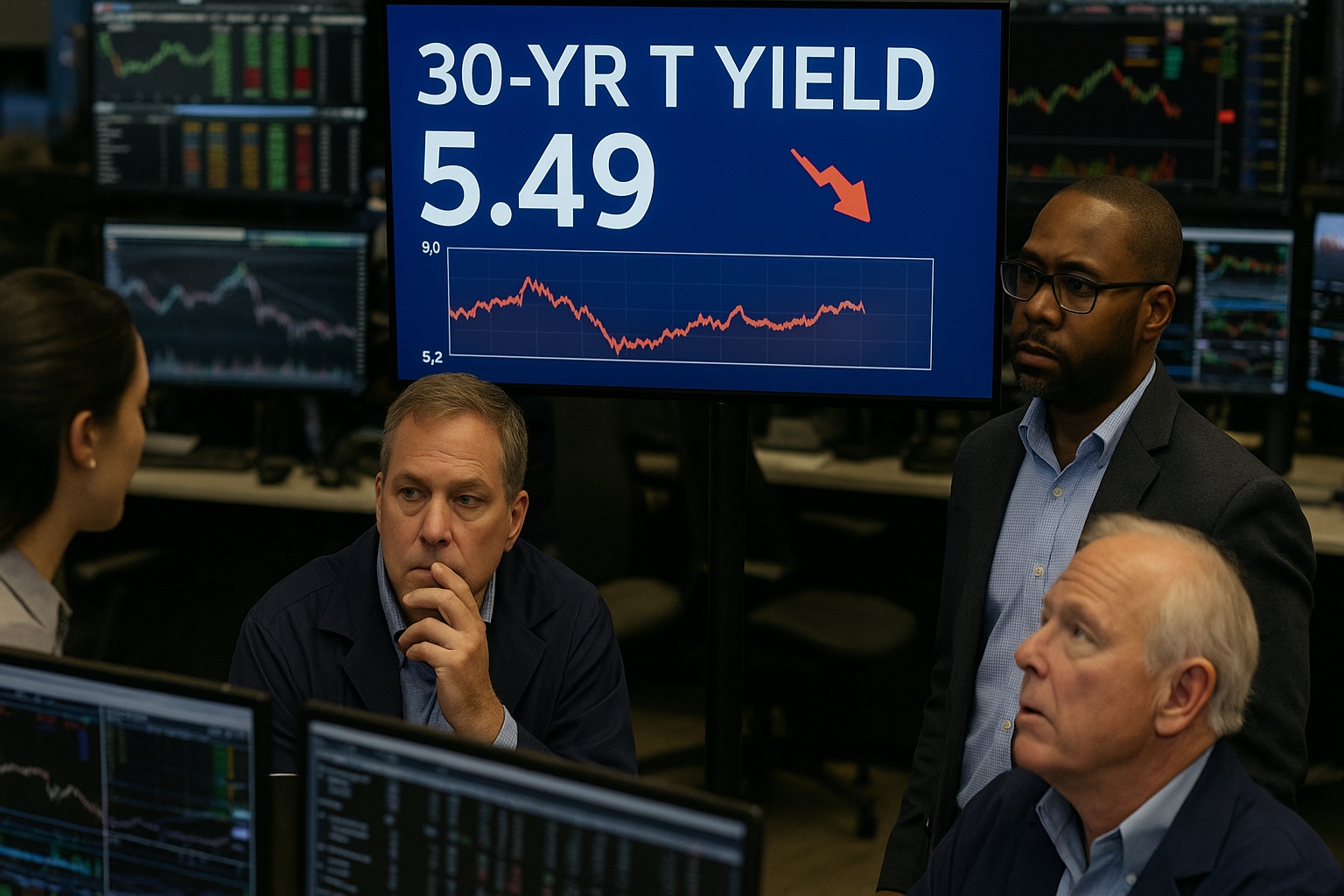
A 5.49% U.S. 30-year Treasury yield just made “safe” portfolios dangerous.
Bloomberg reported that on September 25, the U.S. 30-year Treasury yield finished at 5.49% — around its highest level in more than two decades. That is excellent news if you have cash to deploy. It is also a nasty wake-up call if your wealth plan assumes bonds are harmless, shares can ignore interest rates forever, and refinancing will always be there when you need it.
This isn’t a technical-market story for blokes in suits to argue about on Bloomberg. It is the price of money being reset in public. And when the price of money goes up, nearly every asset you own has to answer for itself.
The 5.49% number matters more than another hot stock tip
On September 24, the 30-year Treasury yield hit 5.44%, its highest level since 2004. By the close on September 25, it was 5.49%. The 10-year Treasury yield, which sits underneath an enormous number of borrowing and valuation decisions, closed at 5.16%.
That is a big deal because the U.S. Treasury market is the global reference point for what “safe” money earns. When the U.S. government has to offer more than 5% for decades of capital, everybody else has to compete with it.
A startup raising money competes with it. A property developer refinancing debt competes with it. A private-equity fund pitching an illiquid deal competes with it. A listed company promising profits in 2034 competes with it. So does the investor who says, “I’ll just keep buying the same growth stocks because that worked last time.”
For years, investors behaved as if there was no alternative to shares. Cash paid bugger-all. Bonds paid little more. So people stretched for risk: expensive technology stocks, private credit, overleveraged property, venture capital, whatever had a chart pointing up and a bloke on the internet calling it generational.
Now, a government bond can offer roughly 5% annual income. Not a promise from a founder. Not a property spruiker’s spreadsheet. A contractual payment from the U.S. government, assuming you hold to maturity.
That does not mean you dump every share you own and become a bond monk. It means the hurdle rate for risk has risen sharply — and too many people have not updated their thinking.
Why yields are climbing
Bond yields rise when prices fall. That sounds backwards at first, but it matters. If you own an existing long-dated bond paying a low coupon, and new bonds arrive paying more, your old bond becomes less attractive. Its market value falls until the yield is competitive.
That is exactly why calling bonds “safe” without mentioning duration is lazy advice.
The recent sell-off has been driven by a fairly ugly mix: elevated energy prices, renewed inflation pressure, solid growth, concern about U.S. government borrowing, and expectations that the Federal Reserve may need to keep rates higher for longer. Markets were pricing three Fed increases over the following year as of September 25.
The oil angle matters. Brent crude sat around US$104 on September 25 even after falling on hopes of progress in the Iran war. Higher energy costs flow through transport, manufacturing, food and household budgets. Then inflation becomes stickier. Then central banks have less room to cut rates. Then long-term bond investors demand more compensation for holding debt.
It is a chain reaction, not a headline.
And this is where ordinary investors get caught: they watch the sharemarket, but the bond market is quietly deciding the cost of nearly everything underneath it.
The bit most investors are getting wrong
Here is the contrarian view: higher yields are not automatically bad news for people building wealth.
They are bad news for people who already own too much long-duration stuff at yesterday’s prices.
If you bought a long-bond fund when yields were pathetic and bond prices were inflated, yes, the repricing hurts. If you bought a house or business that only works with permanently cheap debt, you have a problem too. If your portfolio is concentrated in companies valued on profits that may arrive a decade from now, higher discount rates are not your mate.
But if you are a saver with fresh capital, this is the first genuinely useful fixed-income opportunity many investors have seen in years.
Bloomberg reported that a net US$625 billion flowed into U.S. bond mutual funds and ETFs through August — the strongest comparable stretch in Morningstar data back to 2010. That tells you serious money is noticing the same thing: income has returned.
The mistake would be treating that as an invitation to make one giant, heroic bet on long bonds this week.
Nobody knows whether the 30-year yield peaks at 5.49%, 6%, or somewhere lower after the next inflation print, oil move or Fed statement. Long-duration bonds can still get smashed if yields rise further. A 30-year bond is not cash with a nicer return; it is highly sensitive to changes in interest rates.
The opportunity is not “go all-in on bonds.” The opportunity is that you no longer have to take idiotic risk just to earn a respectable return on part of your money.
That distinction will save people a fortune.
The second-order hit: shares, property and private assets
A 5%-plus Treasury yield puts pressure on asset prices in three ways.
First, it gives investors a credible alternative. If I can earn around 5% from a government-backed instrument, I want a much better prospective return before I lock money into volatile shares, venture funds or speculative property.
Second, it raises financing costs. Companies with debt coming due face higher interest expenses. That means lower profits, less money for buybacks, fewer acquisitions and less room for operational mistakes. A business can look brilliant in a low-rate world and average in a normal-rate world.
Third, it exposes fake liquidity. Private credit, property syndicates and unlisted funds often look wonderfully calm because nobody marks them to market every second. That does not mean the economics are calm. It can simply mean the bad news arrives late.
I have no issue with illiquid assets when the return justifies the lock-up and you understand the risk. But plenty of investors accepted illiquidity, leverage and complexity because a 4% or 5% return looked exciting when cash paid close to zero.
That game has changed.
If a fund wants to lock up your money for seven years, it now has to explain why it is materially better than a simple portfolio of liquid, transparent assets earning proper income. “Our manager knows people” is not a sufficient answer. Neither is a glossy PDF full of castles, warehouses and words like resilience.
Don’t confuse a higher yield with free money
There is another trap here: investors chase the yield but ignore what they are buying.
A government bond yielding 5% is not the same as a junk bond yielding 8%. A dividend share yielding 7% is not automatically safer than a Treasury. And a private-credit fund offering 10% is not giving you an extra 5% because its manager is a genius. You are being paid for risks that may only become obvious when the economy turns.
The return is never the whole story. Ask what can break.
For bonds, ask about maturity. The longer the maturity, the harder the price can move when yields change.
For shares, ask whether the company can grow earnings without cheap capital.
For property, ask what happens when debt rolls over at a higher rate.
For any fund, ask whether you can get your money out when you need it — not when the brochure says you can.
That is not pessimism. That is adult investing.
What this means for you
Here is the practical version. No waffle. Do this over the next week.
1. Check your cash return. If a large cash balance is earning close to nothing, you are volunteering to get poorer after inflation. Compare your bank rate with government bills, term deposits, high-yield savings accounts and money-market options available in your jurisdiction.
2. Look at bond duration, not just the word “bond.” If you own bond funds, find the average duration. Long-duration funds can be far more volatile than people expect. Match the maturity of your money to when you may need it.
3. Stop treating every dollar the same. Money needed in the next one to three years should not be hunting for moonshots. Build a proper liquidity bucket first. The ability to avoid selling good assets during a bad market is one of the most underrated forms of wealth.
4. Re-underwrite your debt. If you have a mortgage, investment loan, business facility or floating-rate debt, run the numbers at rates 1% and 2% higher than today. If that exercise makes you sweat, you do not have a rate problem. You have a leverage problem.
5. Raise your required return. Before buying a speculative share, property deal or private fund, compare it with what you can earn from low-risk income now. If the upside is modest but the downside is ugly, walk away. There will always be another deal.
6. Keep buying quality assets — but demand value. Higher rates do not kill wealth creation. They punish lazy underwriting. Great businesses with pricing power, sensible debt and real cash flow will still compound. You simply do not need to pay any price for them anymore.
The 5.49% 30-year Treasury yield is not a reason to panic. It is a reason to grow up a bit as an investor.
For more than a decade, cheap money made many average decisions look smart. That era is being questioned in real time. The winners from here will not be the people who predict every rate move. They will be the people with liquidity, low leverage, a sane time horizon and the discipline to demand a return worth the risk.
That is how you get richer without needing to be clever every bloody day.