Valentino’s €1.7B Test: Riccardo Bellini Named CEO
Valentino has a €1.7 billion ownership bet to justify — and prettier campaigns will not pay it back. Riccardo Bellini’s job is to turn fashion heat into full-price demand.
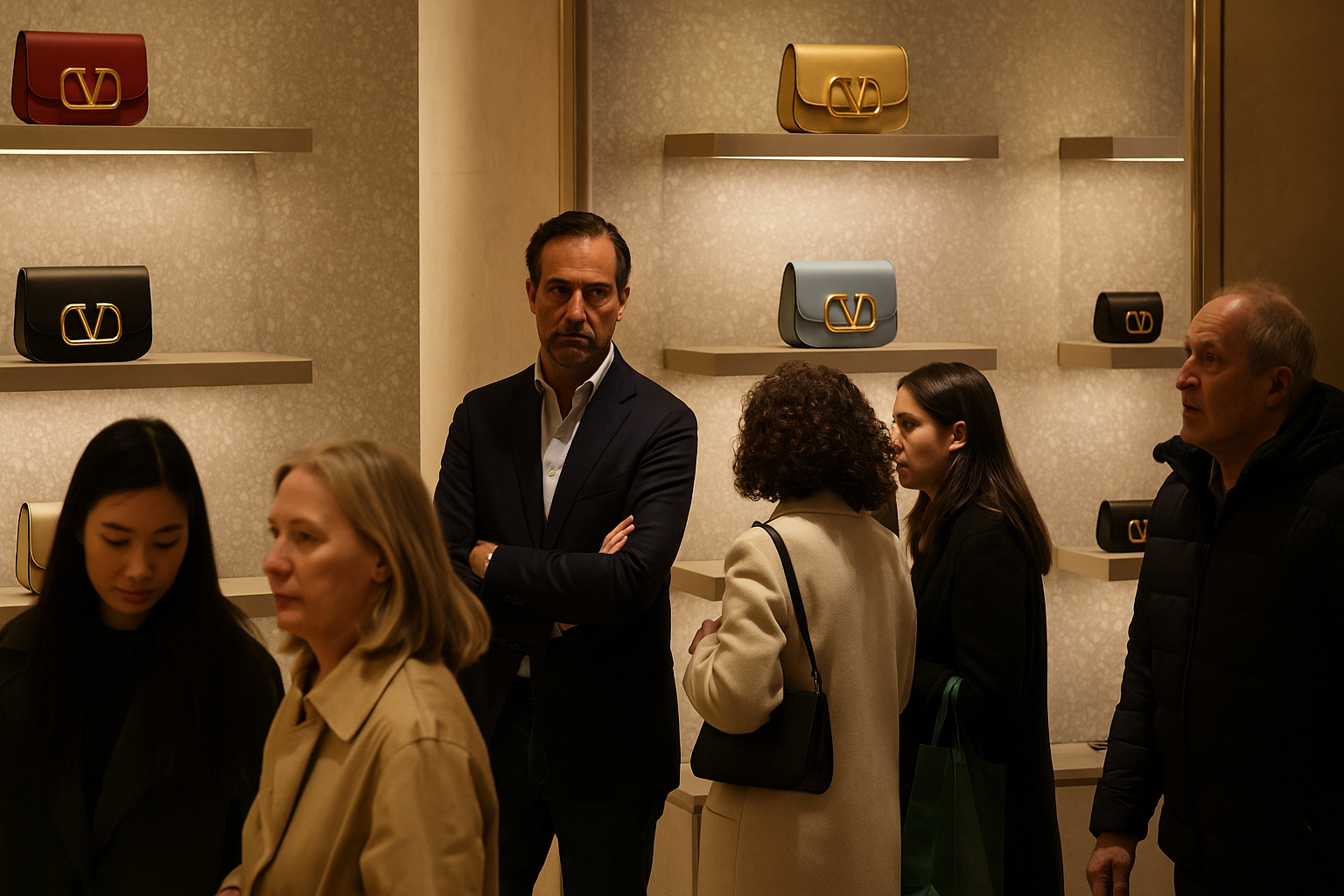
Valentino has spent years selling fantasy. Now it has a €1.7 billion ownership bet to justify — and prettier campaigns will not pay it back.
It needs to sell enough handbags, coats and shoes to justify that bet.
That is the real job Riccardo Bellini has accepted as Valentino’s new chief executive. Not keeping fashion editors happy. Not arranging prettier campaign photos. Converting a famous name, a new creative direction and a very expensive shareholder structure into a business that grows again.
On August 20, Valentino named Bellini CEO, effective September 1, replacing Jacopo Venturini, whose departure had been announced a week earlier. Bellini arrives from Mayhoola, the Qatari investment vehicle that owns 70% of Valentino. He has previously run Chloé and Maison Margiela, and held senior roles at Diesel and Procter & Gamble. That is a serious operating résumé, not a celebrity appointment. ([reuters.com](https://www.reuters.com/world/europe/italys-valentino-hires-fashion-industry-veteran-bellini-ceo-2025-08-20/))
This is not a normal CEO appointment
Most CEO appointments are dressed up as continuity: a board gives the top job to the next polished internal candidate, everyone says lovely things, and then the organisation carries on exactly as before until the numbers force another press release.
This one is different.
Bellini was managing director of Mayhoola, Valentino’s controlling owner. In plain English, the owner has put one of its own senior operators into the cockpit. That tells me Mayhoola does not think Valentino has the luxury of a slow, ceremonial handover. It wants tighter alignment between capital, brand strategy and execution.
The ownership stakes explain why. In 2023, Kering bought 30% of Valentino for €1.7 billion in cash, while Mayhoola retained 70%. The deal gave Kering board representation and included an option to acquire 100% of Valentino by 2028. At the time of that transaction, Valentino reported 2022 revenue of €1.4 billion, recurring EBITDA of €350 million, and 211 directly operated stores across more than 25 countries. ([kering.com](https://www.kering.com/en/news/kering-and-mayhoola-announce-that-kering-becomes-a-significant-a-shareholder-of-valentino-as-part-of-a-broader-strategic-partnership/))
Those numbers matter because a 30% stake bought for €1.7 billion is not a casual punt. It says the shareholders believe Valentino can be an enduring global luxury asset. But belief is not a strategy, mate. A heritage house is only worth what it can earn from customers without training them to wait for a sale.
Bellini inherits an organisation with world-class ingredients: Roman heritage, haute couture credibility, celebrity pull and a global retail footprint. He also inherits the usual luxury headache: the market has been tough, particularly in the US and China, while Alessandro Michele’s early Valentino collections have yet to produce a clear commercial revival. ([reuters.com](https://www.reuters.com/world/europe/italys-valentino-hires-fashion-industry-veteran-bellini-ceo-2025-08-20/))
Alessandro Michele supplies the heat. Bellini must build the engine.
Fashion companies make a basic mistake all the time. They confuse creative noise with commercial momentum.
A creative director can make the brand feel alive. That matters. Alessandro Michele, who became Valentino’s creative director in 2024, has a distinct point of view and an enormous profile from his Gucci years. He can create desire, conversation and a reason for customers to look again.
But a CEO has to answer more boring, more valuable questions.
Which products have real repeat demand? Which stores are generating productive full-price sales? What is the margin after leases, staff, marketing and inventory? Are wholesale partners helping the brand or discounting its mystique into oblivion? Is the supply chain built for speed without compromising quality? Is the company selling a coherent wardrobe and accessories proposition, or merely staging expensive moments on a runway?
That division of labour is why Bellini is a sensible choice. He is not coming in to out-design the designer. He is coming in to make the creative vision survivable in a difficult market.
The best CEOs in luxury understand that brand heat and business discipline are not enemies. Discounting may clear stock this quarter, but it can wreck the price integrity that makes a luxury house valuable for the next decade. On the other hand, stubbornly protecting an artistic vision while customers do not buy it is not integrity. It is denial with a better soundtrack.
Bellini’s first test will be whether he and Michele can hold both truths at once: protect the house’s identity while being ruthlessly honest about what customers are actually buying.
The overlooked angle: this is a shareholder-management move
Everyone will focus on the change at Valentino. The sharper read is the signal it sends inside the Mayhoola-Kering relationship.
Kering is not a passive financial investor. It owns Gucci, Saint Laurent, Bottega Veneta and Balenciaga. It understands luxury distribution, leather goods, store economics and the brutal cost of rebuilding a house after creative or commercial drift. Mayhoola remains the majority owner, but Kering has capital at risk, a board seat and an option that could lead to full ownership by 2028. ([kering.com](https://www.kering.com/en/news/kering-and-mayhoola-announce-that-kering-becomes-a-significant-a-shareholder-of-valentino-as-part-of-a-broader-strategic-partnership/))
That makes Valentino’s CEO role unusually exposed. Bellini is not managing for one founder, one private-equity timetable or one public-market quarterly call. He is working between a controlling shareholder and one of the world’s biggest luxury groups, both of which have every reason to care about brand value and every reason to disagree about pace, investment and control.
This is why bringing in the owner’s managing director is more consequential than it looks. Bellini already understands Mayhoola’s capital logic. He will also need to earn credibility with Kering, with Michele, with Valentino’s merchants and with the people running its stores. A CEO without those relationships becomes a very well-dressed messenger. A CEO with them can make decisions before the window closes.
There is a lesson here for founders and investors well beyond fashion: when ownership is complicated, strategy cannot live in a PowerPoint deck. The operating leader must understand what each capital partner is trying to protect, what they are willing to fund, and where their patience ends.
Don’t worship the external hire
Here is the contrarian bit: companies routinely convince themselves that an outsider is automatically bolder, while an insider is automatically compromised. That is lazy thinking.
The right question is not, “Did we hire from outside?” It is, “Does this person see the problem clearly enough to make the difficult call?”
Bellini is an insider to the ownership group but not an internal Valentino lifer being promoted to preserve old habits. That can be a useful middle ground. He knows the shareholder agenda, but he has operated other luxury houses. He is close enough to move fast and far enough away to challenge the furniture arrangement.
Of course, proximity to the owner can become a problem if it makes people below him feel that decisions are imposed rather than earned. The cure is not another strategy offsite. It is visible operating behaviour: clear priorities, named accountabilities, fast decisions on product and distribution, and leaders who know whether they are being measured on revenue, margin, inventory turns, customer retention or all of the above.
People can handle a hard plan. What destroys organisations is a vague one.
What this means for you
You probably do not run a Roman fashion house with a €1.7 billion shareholder transaction hanging over it. Lucky you. But the management lesson is extremely practical.
First, separate attention from demand. Your customers posting about your product, your staff cheering a launch, and your industry mates telling you the brand feels exciting are not proof that you have a business. Track full-price conversion, repeat purchase, gross margin and cash tied up in stock. Applause does not pay suppliers.
Second, make the creative person and the commercial person jointly accountable. In any business, one team creates the promise and another delivers it. Product and sales. Marketing and operations. Founder and CFO. If those groups run separate scoreboards, customers eventually notice the gap. Put them in the same room with the same numbers.
Third, know who owns the clock. Bellini’s appointment shows that shareholders have different levels of patience. Your board, investor or co-founder may say they support long-term thinking. Fine. Find out exactly what they expect in the next 90 days, 12 months and three years. Vagueness is where partnerships go to die.
Finally, hire operators for the moment you are actually in. If the issue is growth, hire someone who has grown something. If the issue is broken execution, do not hire another storyteller. Valentino has plenty of creative firepower. Bellini has been brought in to turn it into a machine that earns.
That is the job. Everything else is window dressing.