Volkswagen’s 50,000-Job Reality Check: Oliver Blume Has No Easy Exit
50,000 German jobs are going because Volkswagen let complexity become a cost base it could no longer defend. That is what hard choices cost when leaders wait.
Volkswagen has agreed to cut 50,000 jobs in Germany by 2030. That is not a turnaround plan. It is the bill arriving after too many years of a giant business being allowed to confuse size with strength.
CEO Oliver Blume is now touring factories, telling workers that the cost-cutting journey is not over, while unions brace for another fight over jobs, plant closures and the future of Europe’s biggest carmaker. Reuters reports that management is considering an even bigger overhaul, potentially including more job reductions, factory closures and carve-outs of parts of the business.
That is brutal stuff. It is also what leadership looks like when reality has finally beaten politics.
Oliver Blume is managing a problem bigger than payroll
Volkswagen is not a small company having a bad quarter. It is an industrial institution with more than half a million people, a sprawling portfolio of brands, huge factories, powerful unions, a politically sensitive home state and decades of organisational baggage.
The problem is that the world has moved faster than Volkswagen’s cost base.
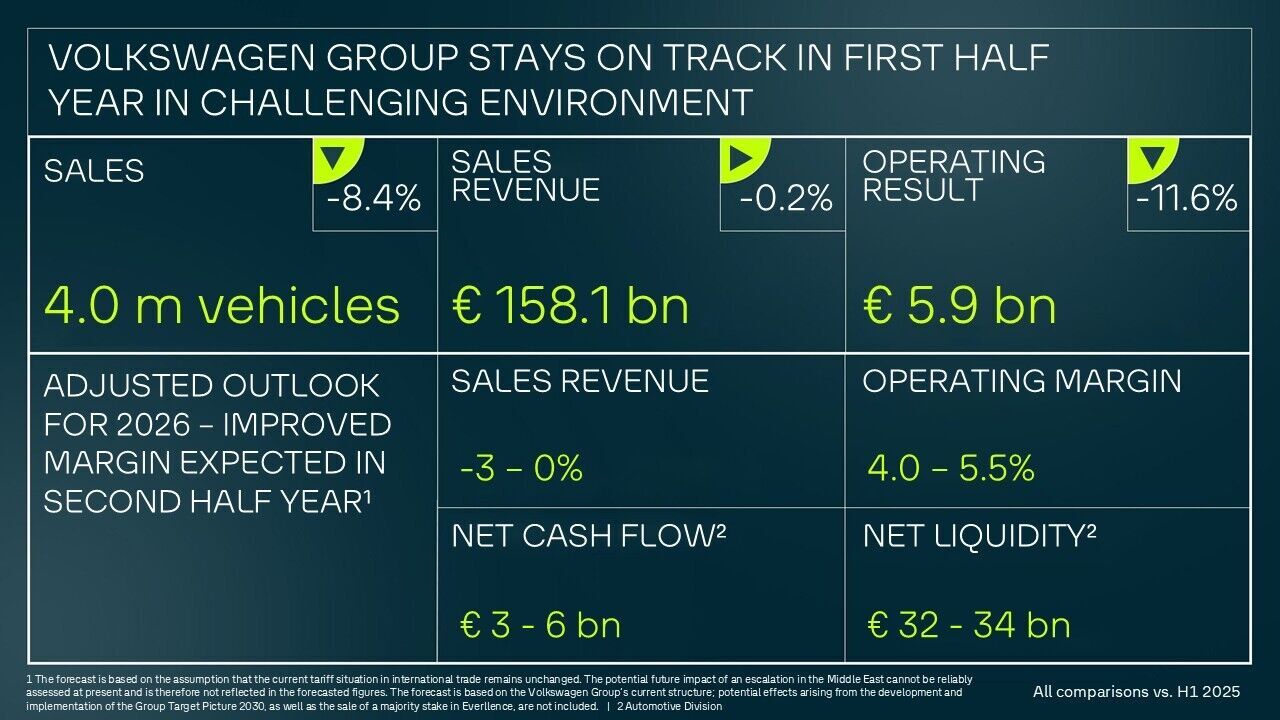
Chinese manufacturers are no longer merely making cheap vehicles for China. They are arriving in Europe with electric cars and plug-in hybrids that are increasingly competitive on technology, features and price. Volkswagen is also dealing with a weaker China business, softer European demand and the damage caused by US tariffs. In the first half of 2026, the group reported €158.1 billion in revenue but operating profit fell to €5.9 billion, producing a skinny 3.8% operating margin. That is not enough room to fund a capital-intensive transition, absorb shocks and invest properly in the next generation of cars. ([volkswagen-group.com](https://www.volkswagen-group.com/en/press-releases/volkswagen-group-stays-on-track-in-challenging-environment-and-expects-improved-margin-in-the-second-half-of-the-year-20542))
Blume has been unusually clear about the internal benchmark. At the Emden plant, he told workers that labour costs were more than double those of comparable European locations, and that other factories remained materially cheaper. That is the sentence every operator should sit with.
Not because workers are the enemy. They are not. But because a business cannot negotiate its way out of basic arithmetic.
When your costs are structurally wrong, good people working harder does not fix the model. A shiny strategy deck does not fix it either. Eventually, the CEO has to choose: simplify the business while he still controls the process, or wait until the market does it for him with worse terms.
The numbers matter because the management choices do
Volkswagen’s official position is that about 50,000 positions across Volkswagen, Audi, Porsche and software unit CARIAD in Germany are set to be reduced by 2030. The company says around 37,000 agreements have already been signed, largely using voluntary measures and phased retirement. Its target is more than €6 billion in annual net cost savings by 2030. ([volkswagen-group.com](https://www.volkswagen-group.com/en/oliver-blume-on-competitiveness-transformation-and-growth-20605))
That is the announced program. Separately, Reuters has reported that executives have considered a broader restructuring that could take the potential job-cut number as high as 100,000, alongside possible plant closures and business carve-outs. That figure is not Volkswagen’s settled public target, and pretending otherwise would be sloppy. But the fact it is being seriously discussed tells you where the pressure sits. ([investing.com](https://www.investing.com/news/stock-market-news/volkswagen-ceo-tells-factory-staff-costcutting-journey-is-not-over-4876693))
This is the key distinction: 50,000 is the agreed medicine. Up to 100,000 is the kind of surgery management may believe is necessary if the patient does not respond.
A lot of executives will look at this and say, “Well, Volkswagen should have acted earlier.” Correct. But that is a cheap observation from the grandstand. The useful question is why it did not.
Because in big companies, delay has powerful defenders.
Every plant has a local constituency. Every brand has senior people protecting its own little kingdom. Every legacy product has someone who built a career around it. Every complexity has an internal owner. Add a board structure with worker representation and political stakes, and decisive action becomes a hostage negotiation.
I have seen versions of this in much smaller businesses. The company is not actually short of smart people. It is short of people willing to kill a project, a layer, a meeting, a supplier relationship or a product line that has stopped earning its place.
That is how complexity becomes culture. Then culture becomes cost. Then cost becomes layoffs.
The overlooked issue is not headcount. It is complexity.
Everyone will focus on the job number because it is human, visible and politically explosive. Fair enough. But the deeper management story is Volkswagen’s attempt to reduce the complexity that made its cost base so stubborn in the first place.
The group has signalled plans to streamline its model range by up to 50% and reduce offering complexity by up to 75%. That matters far more than another generic promise to “find efficiencies.” Every additional model, variant, component choice, software requirement and internal approval path adds cost long before a car reaches a showroom. ([volkswagen-group.com](https://www.volkswagen-group.com/en/oliver-blume-on-competitiveness-transformation-and-growth-20605))
This is where most corporate turnarounds get it wrong. They start with people because people appear on the payroll line. But payroll is often the symptom.
The disease is usually a business that has too many exceptions.
Too many products for too few customers. Too many layers between decision and delivery. Too many systems doing roughly the same thing. Too many leaders with the authority to delay but not the accountability to decide.
If Volkswagen cuts jobs while keeping the same complexity, it will simply make the remaining people miserable and slower. That is not transformation. That is corporate starvation.
Blume’s real test is whether he can get the group to make fewer things, make decisions faster and build vehicles at a cost that does not require heroic sales volumes to generate a decent return.
That is much harder than announcing a job number. Anyone can announce a job number.
The contrarian view: Blume may be too cautious, not too ruthless
The standard storyline will paint Oliver Blume as the bloke demanding cuts while workers and unions defend jobs. That makes for neat headlines. It may also miss the point.
A CEO who tells employees the factory is competitive when it is not is being kind for five minutes and cruel for five years.
Volkswagen’s workers council chief Daniela Cavallo has argued that job cuts and plant closures do not solve the deeper problems created by tariffs, Chinese competition and weak European demand. She is right about one important thing: cuts alone are not a strategy. ([live.euronext.com](https://live.euronext.com/en/financial-news/volkswagen-ceo-labour-boss-dig-ahead-key-board-meeting))
But management also has a point that is less pleasant: tariffs and competition do not disappear because a factory has history. If comparable plants can produce at radically lower cost, the gap must be dealt with somehow. Governments can cushion it. Unions can shape it. Boards can delay it. None of them can repeal it.
The contrarian call here is that Blume should not be judged by how many jobs he saves this quarter. He should be judged by whether the jobs left in 2030 sit inside a company that can actually compete without permanent protection.
That requires honesty about capacity. It requires speed. It requires a plan for products and software, not merely a plan for exits. And it requires senior leaders to give up turf before asking frontline workers to give up security.
If the executive floor remains bloated with duplicated brands, committees and pet projects while factories take the pain, Volkswagen will deserve the backlash it gets.
What this means for you
You do not run Volkswagen. Good news: you do not need to, because it looks like a headache with wheels.
But the operating lesson is dead useful.
Before your next budget meeting, find the three products, processes or management layers that nobody can defend with a straight answer on customer value, margin or speed. That is where your Volkswagen problem starts—not when you announce cuts, but when you keep funding complexity because nobody wants the argument.
First, measure your business against the best alternative, not last year. Blume’s message at Emden was uncomfortable because he compared the plant with better locations, not with its own history. Do the same. Ask what a sharper competitor could deliver your product, service or outcome for today. Not what it cost you in 2024.
Second, attack complexity before you attack morale. Make a list of every product, customer segment, report, recurring meeting, approval and software tool. Then ask one ruthless question: does this earn its place? If the answer is vague, it probably does not.
Third, do not call a cost-cutting plan a strategy. Costs need to come out. Fine. But write down precisely what becomes better afterward: faster product development, cheaper delivery, better customer experience, higher margins or more cash to invest. If you cannot explain the post-cut business, you are just shrinking.
Finally, tell people the truth while there is still time to act. The worst leadership move is false reassurance. The second worst is panic. The job is to state the facts, make the hard calls early and show the capable people why staying through the pain is worth it.
Volkswagen’s 50,000-job program is ugly because corporate failure to simplify is ugly. The lesson for founders, investors and operators is not merely that complexity is expensive. It is that every exception you tolerate today becomes a decision you are forced to make later, under worse conditions and with fewer good options.
Complexity is never free. It just sends the invoice later—usually when the business can least afford it.