Wispr’s $280M Series B at $2B Is a Brutal Test for Every AI App
A dictation app just raised $280 million at a $2 billion valuation. If Wispr cannot turn voice into a daily habit with that much cash, plenty of AI startups are kidding themselves.
Most AI startups do not have a technology problem. They have a habit problem.
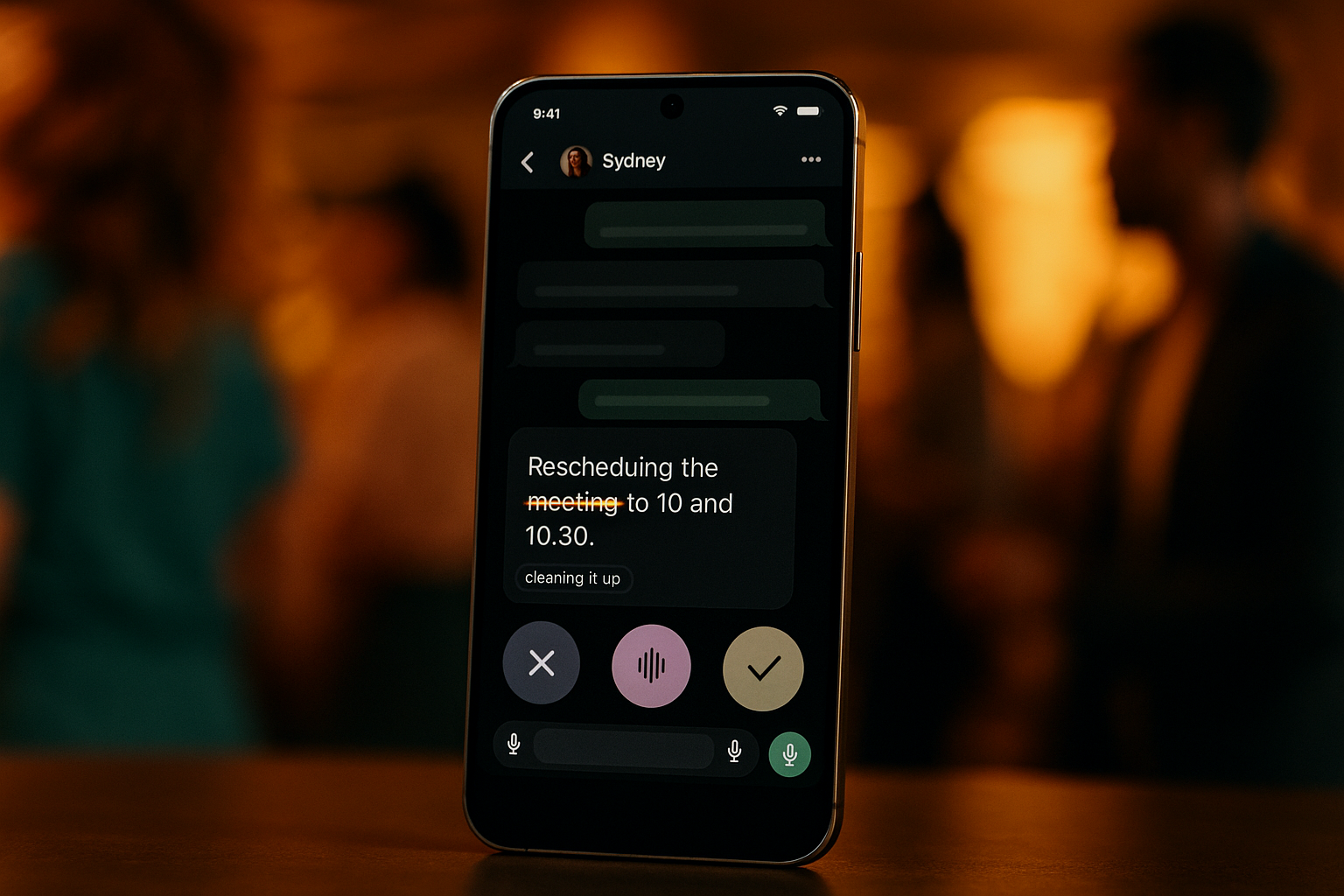
Wispr has just raised $280 million at a $2 billion valuation to solve one of the oldest, most obvious problems in computing: people can speak faster than they can type, so why are we still pecking away at keyboards like it is 1998?
That is a massive cheque for what, on the surface, looks like a dictation app. Good. It should make founders uncomfortable.
Because Wispr is not being priced as a nicer microphone button. Menlo Ventures and a long list of existing and new backers are betting that Wispr Flow can become a new input layer for how people work: emails, documents, messages, meetings and, eventually, whatever comes after apps as we know them.
That is a proper ambition. It is also a brutal execution test.
The $280 million bet is not really about dictation
Wispr announced its Series B on August 17, led by Menlo Ventures, at a $2 billion valuation. Existing investors including Notable Capital, NEA, Neo Ventures, 8VC and MVP Ventures returned. New investors included Acrew, Forerunner, Goodwater, Peak XV, Together Fund and PLUS Capital.
The round brings Wispr’s total funding to roughly $361 million. That is serious money for a company founded in 2021 whose best-known product, Wispr Flow, lets users dictate into text fields across their devices while cleaning up filler words, grammar and formatting.
The company has also rolled out a meeting notetaker and launched its Advanced Interfaces Lab. In plain English: it is trying to move from “talk instead of type” to “talk and have the computer understand what you meant, where it belongs and what should happen next.”
That is why the valuation matters. A $2 billion price tag does not say investors think there is a fortune in replacing keyboards for a few power users. It says they believe voice can become a durable, everyday interface between knowledge workers and software.
Wispr says Flow is used by millions of consumers and 100,000 businesses, and that revenue has grown more than 150% for four consecutive quarters. Those are company-reported figures, so treat them as signals rather than gospel. But they explain why investors are leaning in rather than politely waiting on the sidelines.
A funding round is not proof of a business. It is proof that smart people are willing to finance the attempt. Those are very different things.
Accuracy is the whole bloody game
Wispr’s biggest announcement alongside the money was a preview of its proprietary speech model, Canto.
The company says Canto can reduce word-error rates in difficult conditions from more than 30% to somewhere between 5% and 10%. The difficult conditions are the ones that actually matter: traffic, wind, noisy offices, music, accents and the rest of real life.
This is the point every founder building an AI product needs tattooed on their forehead: a product is not useful because it works in a demo. It is useful when people trust it while distracted, rushed and slightly annoyed.
Voice technology has been promising to change computing for decades. We have all tried it. We have all sworn at it. The issue was never whether software could turn clean audio into mostly correct words. The issue was whether it could do that reliably enough that you stop checking its work.
That is the threshold.
If I dictate an email and have to fix every fourth sentence, I have not saved time. I have merely added a quality-control job to something I already knew how to do. Worse, I have broken my train of thought. The tiny pauses to correct an error are where the original idea disappears and the admin takes over.
Wispr’s founders understand this. They are putting accuracy at the centre of the pitch, not treating it as one feature on a long roadmap. Sensible. In this category, accuracy is the product.
But there is nowhere to hide now. With $280 million in fresh capital, users will not accept “pretty good.” They will expect the thing to work in the car, at an airport, with an Australian accent, while they are tired, and inside the messy workflow they already use.
That is a high bar. It is also the only bar that matters.
The real opportunity is not speech-to-text. It is intent-to-action.
The overlooked part of this story is that transcription is probably the least valuable thing Wispr can do.
Plenty of companies can transcribe. The market is already crowded with dictation tools such as Willow, Monologue, Aqua and Superwhisper, while meeting products like Granola, Fireflies and Read AI are fighting for their own patch of the workflow.
Cheap and free alternatives will keep coming. They should. That is what happens when a category proves there is demand.
Wispr’s real chance is to own the layer between a person having an idea and software doing something useful with it. That means understanding context, tone, application, recipient, work history and permissions. It means knowing that “send a follow-up to Sarah” is not a sentence to transcribe but a job to complete.
That is a much bigger business than dictation. It is also much harder.
Once a product begins to act rather than merely write, the risks multiply. It needs to be right. It needs to respect privacy. It needs clear permissions. It needs to know when to ask a question instead of making a confident mess. Every operator who has watched a junior employee send an email they should have held for five minutes understands the problem.
The winners in AI will not be the companies with the flashiest output. They will be the ones users trust with the boring, high-frequency decisions that consume a working day.
Wispr has a credible wedge because writing is everywhere. You do not need to convince people to create a new behaviour from scratch; you need to make an existing behaviour faster and less painful. That is far better than asking users to visit another AI dashboard they will forget by Friday.
Here is the contrarian bit: $280 million could make Wispr worse
Big rounds are celebrated because people enjoy seeing a startup get rich on paper. I get it. But money is not automatically an advantage. It is fuel, and fuel makes a bad driver reach the crash faster.
Wispr now has the capital to hire aggressively, build models, expand internationally, chase enterprise contracts and bolt on more products. It also has the capital to lose focus.
The danger is obvious: turning a product people love because it is fast and simple into a bloated “voice operating system” full of tabs, settings, integrations and features no one asked for.
Founders regularly make this mistake after a major round. They confuse a larger bank balance with permission to broaden the mission before the core habit is nailed down. Suddenly the company is building for every user, every device and every use case. The product gets heavier. The message gets vaguer. Growth slows, and everyone acts surprised.
Wispr should do the opposite.
Its first job is to make Flow so reliable that a user feels handicapped without it. The metric I would obsess over is not downloads, meeting minutes or press mentions. It is the percentage of active users who dictate meaningful work every day without editing the output into oblivion.
That is the moat: not a speech model in isolation, but a trusted habit, personal context and a product that gets better because people use it constantly.
The valuation is a warning to the rest of the market
A $2 billion valuation for a voice-product company tells every founder something useful and slightly unpleasant.
Investors will still pay up for AI applications. But they are increasingly paying for products that show a believable route to becoming part of the user’s daily operating rhythm. A thin wrapper with a nice landing page is not enough. Nor is a generic promise to “transform productivity.” That phrase should be put in a bin and set on fire.
Wispr has a clear wedge: replace a universal, painful behaviour with a faster one. It has obvious frequency: people write all day. It has a plausible expansion path into meetings and actions. And it is tackling a technical weakness that users can feel immediately: unreliable recognition in the real world.
That is what a strong AI application thesis looks like.
It is not enough to say your market is enormous. Every founder says that. You need to show why users will return tomorrow, why the product becomes more valuable with continued use, and why a cheaper competitor cannot simply copy the useful bit.
What this means for you
If you are a founder, stop asking whether AI can create your product. Ask whether it can remove a repetitive, expensive or mentally draining behaviour that customers already perform every week.
Then get brutally specific. What is the moment of friction? How often does it happen? What does failure cost the user? And what has to be true before they trust your product without checking it?
If you are an operator, do not buy AI tools because your competitors have them. Pick one workflow where output is measurable: sales follow-ups, meeting actions, client notes, internal documentation or proposal drafting. Give the tool a defined team, a defined job and a 30-day test. Measure time saved, error rates and whether people keep using it when no one is watching.
If you are an investor, be careful with the phrase “AI infrastructure.” The more interesting value may sit above the model layer, in products that win daily user behaviour and then earn the right to automate the next step.
Wispr has raised enough money to find out whether voice is finally ready to be a primary way we work. The company has a real shot.
But the money is not the story. The story is whether people will trust it enough to stop reaching for the keyboard.