WM’s $26.5B Succession Test: John Morris Gets the CEO Job on January 4
Most CEO successions are expensive theatre. WM has given John Morris 131 days to prove its decades of “planning” is more than a boardroom bedtime story.
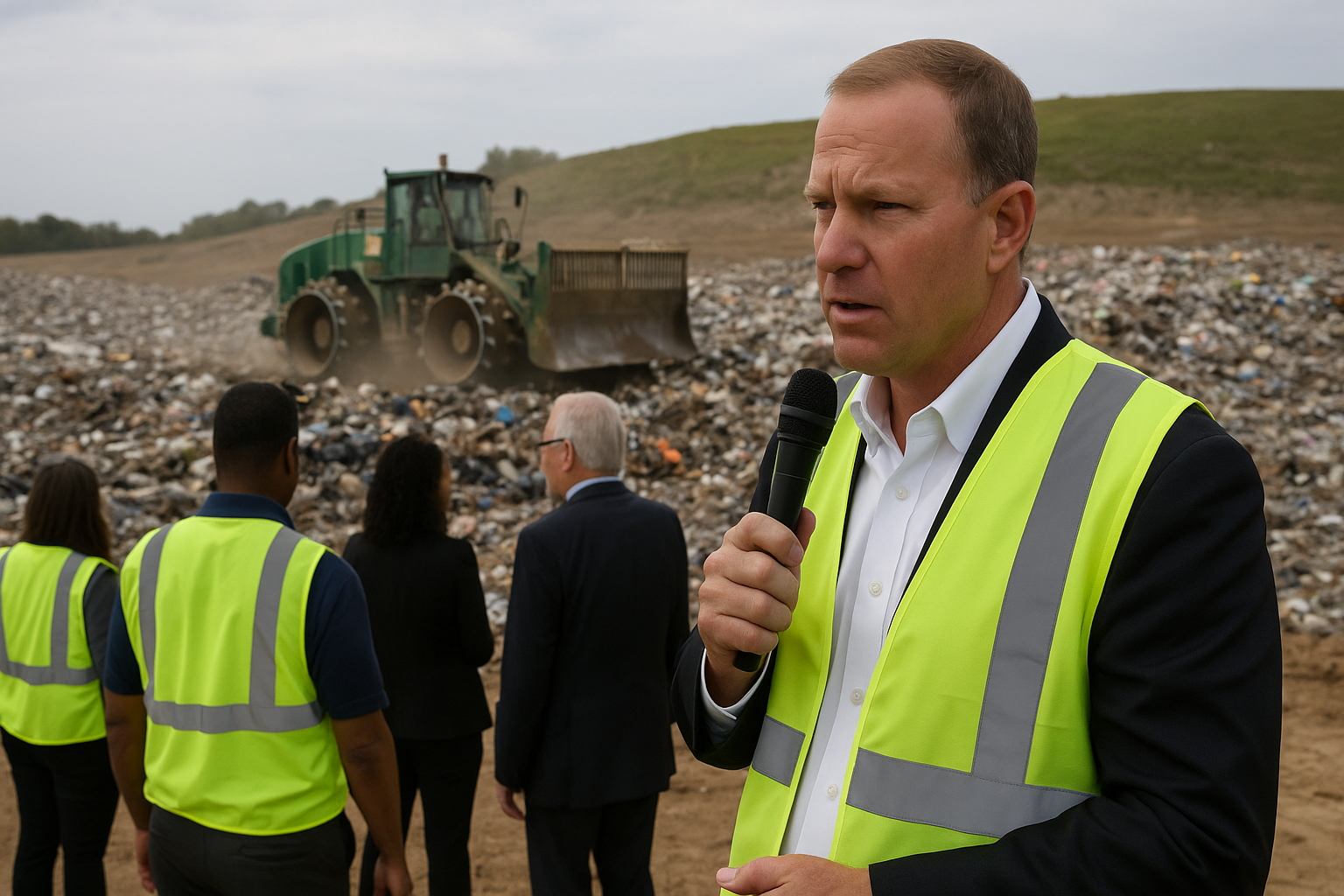
WM is about to hand a $26.5 billion machine to a bloke who has already been operating the engine room. If John Morris cannot make this transition look boring, the board has wasted years pretending succession planning is a real discipline.
Jim Fish Is Leaving a Business That Cannot Afford a Wobble
WM announced on August 26 that CEO Jim Fish will retire and leave its board on January 4, 2027. John Morris, the company’s president and chief operating officer, will become president, CEO and a director on the same date. Fish will have spent more than a decade as CEO and more than 25 years at the company by the time he exits. ([advfn.com](https://www.advfn.com/stock-market/NYSE/WM/stock-news/99196011/form-8-k-current-report?utm_source=openai))
That matters because this is not a cute little changing-of-the-guard exercise at a software firm where a new CEO can reshuffle the org chart, add some AI nonsense to the homepage and call it transformation.
WM runs an enormous physical network: collection routes, landfills, recycling plants, renewable-energy assets, trucks, transfer stations, healthcare-waste operations, customer contracts and thousands of frontline workers. The business does not pause while the incoming CEO learns where the bodies are buried. In this industry, the bodies are literal regulated waste, and somebody still has to pick it up on Tuesday morning.
The company’s latest outlook puts 2026 revenue between $26.275 billion and $26.475 billion, adjusted operating EBITDA between $8.15 billion and $8.25 billion, and free cash flow between $3.75 billion and $3.85 billion. That is the scoreboard Morris inherits. Not a turnaround. Not a rescue mission. A high-performing, capital-heavy operation where a small slip in pricing, labour, fleet uptime or integration can chew through a lot of money very quickly. ([investors.wm.com](https://investors.wm.com/news-releases/news-release-details/wm-announces-second-quarter-2026-earnings/?utm_source=openai))
Fish leaves with the sort of financial backdrop boards dream about when they are writing glowing retirement statements. WM delivered $6.684 billion in second-quarter revenue, $2.067 billion in adjusted operating EBITDA and $1.10 billion in free cash flow. It also returned $1.04 billion to shareholders in that quarter alone through $659 million of buybacks and $379 million in dividends. ([investors.wm.com](https://investors.wm.com/news-releases/news-release-details/wm-announces-second-quarter-2026-earnings/?utm_source=openai))
Good. But that is exactly why this handover is a test. It is easy to take over when everyone is desperate. The real operators take over when expectations are high and there is nowhere to hide.
John Morris Has Been Auditioning Since May 2025
Morris is not a parachuted-in “visionary.” Thank God for that.
WM promoted him to president in May 2025 while he retained the COO job. At the time, he was given responsibility for field operations, with the chief officers for sustainability, customer experience and enterprise strategy reporting to him. Before becoming COO, Morris worked as New York City market-area general manager, Greater Mid-Atlantic area vice president, chief strategy officer and senior vice president of field operations. He has more than 30 years in the industry. ([mediaroom.wm.com](https://mediaroom.wm.com/2025-05-14-WM-Names-John-Morris-President?utm_source=openai))
That career path is the actual story here.
Too many boards confuse a successor with a resume. They hire somebody who has “global experience,” says the right things at investor conferences and knows how to wear an expensive jacket. Then they act stunned when that person cannot make decisions at 5:30 a.m. about workforce safety, customer service failures, operational bottlenecks and capital allocation.
Morris has run the parts of WM where reality turns up uninvited. He has field experience, strategy experience and operating accountability. More importantly, he has spent 19 months as president and COO before taking the big chair. That is not accidental. It is a live-fire succession plan.
The board has effectively had a long trial period: let Morris own the operations, expose him to enterprise leadership, put him beside Fish in quarterly reporting, and see whether the business keeps producing cash. That is how an adult board handles succession.
There is a difference between grooming a successor and protecting one. WM appears to have done the former. Morris has had real responsibility, not a ceremonial title and a few strategy off-sites.
The Big Job Is Bigger Than Bins
Calling WM a rubbish company is like calling a bank a building with tellers. Technically true. Financially stupid.
The legacy collection-and-disposal business remains the core cash machine, but the company is increasingly building around recycling, renewable natural gas and healthcare waste. Its 2025 revenue reached $25.204 billion, up 14.2% from 2024, driven largely by acquisitions — particularly Stericycle — alongside higher pricing and greater landfill, renewable-energy and recycling volumes. ([investors.wm.com](https://investors.wm.com/static-files/0f0c279f-108a-4f21-8bc2-13d878a285c8?utm_source=openai))
The Stericycle acquisition now sits within WM Healthcare Solutions. It is strategically sensible: regulated medical waste gives WM another dense, sticky and operationally demanding service line. But “strategically sensible” is boardroom language for “now somebody has to make the numbers work.” Integration costs, systems, sales processes, labour models and customer retention are where acquisitions either create value or become a very expensive slide in an investor deck.
Morris also inherits the company’s push into renewable-energy and recycling assets. In the second quarter, WM completed three renewable natural gas facilities — two in South Carolina and one in Florida — expected to add roughly 3.5 million MMBtu of annual run-rate production. It also completed a Denver recycling facility with about 60,000 tons of annual processing capacity. ([investors.wm.com](https://investors.wm.com/news-releases/news-release-details/wm-announces-second-quarter-2026-earnings/?utm_source=openai))
That is not sustainability cosplay. It is capital allocation.
These assets need disciplined construction, good operating performance and a hard-headed view of returns. Every CEO loves saying they are investing for the future. The smart ones can tell you, without blinking, what the cash return is, what could break, who owns it and what gets cut if the maths turns ugly.
The Overlooked Risk: Success Can Make a New CEO Soft
Here is the contrarian bit: Morris’s biggest risk is not that he changes too much. It is that he changes too little.
When a company has strong margins, a reliable core business and a well-liked predecessor, the temptation is to preserve everything. Preserve the strategy. Preserve the team. Preserve the rituals. Preserve the old boss’s pet projects. Before long, you are not running the business; you are curating a museum dedicated to the last CEO.
Fish built a strong platform. That does not mean every decision that made sense under Fish will make sense in 2028.
WM’s latest quarter showed the strengths and the pressure points. Adjusted operating EBITDA margin reached 30.9%, while recycling and renewable-energy EBITDA grew 32.5% year over year. At the same time, the company trimmed its revenue outlook by about 0.6% because of lower expected volumes, even while maintaining its profitability and cash-flow targets. ([investors.wm.com](https://investors.wm.com/news-releases/news-release-details/wm-announces-second-quarter-2026-earnings/?utm_source=openai))
That is the lesson for Morris: pricing, productivity and cost control can protect earnings for a while. But a CEO cannot permanently engineer around weak volume with clever spreadsheets and better surcharge recovery. He needs to know where growth is real, where it is bought, and where the company is simply charging more to carry the same bloody bin.
This is why internal succession is not automatically conservative. Done properly, it gives the new CEO enough institutional knowledge to move faster. Morris should use that advantage. He knows which parts of WM are genuinely world class, which parts are merely tolerated because they have always been there, and which leaders are better at explaining than executing.
What This Means for You
Whether you run a 12-person company, lead a division or own shares in one, take the useful lesson from WM’s handover.
First, stop treating succession as an emergency document. If your business falls apart because one person leaves, you have not built a business. You have built a hostage situation with payroll.
Second, give potential successors a proper operating test. Do not just make them “head of strategy” or stick them in board meetings. Put revenue, people, costs and ugly decisions in their lap. Morris’s route through field operations, strategy, COO and president is a far better model than the usual corporate beauty pageant.
Third, separate a successor’s competence from your own ego. Founders and long-serving CEOs often sabotage succession because they cannot bear the idea that someone else might do the job differently. Different is not disloyal. Sometimes it is the entire point.
Finally, set the scorecard before the transition, not after. For Morris, the obvious markers are execution in the core collection-and-disposal business, profitable integration of Healthcare Solutions, return discipline on renewable-energy and recycling projects, safety, customer retention and cash generation. If those are humming 12 months after January 4, the transition worked. If the company is issuing vague statements about “strategic repositioning,” start checking under the bonnet.
A good succession should disappoint the pundits because it is dull. No palace coup. No heroic outsider. No frantic turnaround deck. Just the right person, prepared early, taking responsibility for a serious business.
That is not boring management. That is management done properly.